I travelled in time for a couple hours this morning.
But don't worry; I'm back in one piece, and took a shower. I'm back.
And besides, it's my day off; what was I supposed to do?
My "day off," as with most "preacher-types," is Monday ("
the day after"); and that makes it a "recovery day." And that, in turn, qualifies it as a sabbath of sorts.
Man is made for the sabbath; and Sabbaths are made for travel.
Or something like that.
Before you write me off as so "loco" as to need many more "days off," or enforced "sabbathical," hear me out on the time travel reference. After all, my time travelling jaunt was in part encouraged by the sage advice of a theologian most readers of a site such this would recognize as no slouch: Abraham Heschel. In his classic, "The Sabbath," this wonderful Jewish thimker suggests that the sabbath is "holiness in time," a "palace" in time. His thesis is that Judaism (and by extension, Christianity) is fundamentally a religion of time; not space. Any ultimate "travelling" a pilgim does; is essentially in time (which of course, is no small insight for a religion often hallmarked...wrongly, Heschel would say...by "holy" sites, places; and "holy land.") The shabbat, then, as a timely visitation of the Eternal, is the sanctification; the holy-izing of time. "Sabbaths are our grand cathedrals." Heschel scholars reading this, forgive my translations: I am currently reading Heschel...who thought in Hebrew and wrote in English...in Spanish. It's a deep, dizzying; confusing and enlightening cross-cultural experience...
...Kind of like..uh, time travel.
Please, wrestle with Heschel (in any language);
here is a place to start; or try on this article, excerpted from the "Sabbath" book:
"Shabbat as a Sanctuary in Time: The Sabbaths are our great cathedrals, the Jewish equivalent of sacred architecture". But back to my time travel. Don't call my wife; or the men in the white coats.
All I did this morning was read a novel.
But that in itself is time travel:
"At the moment when art is experienced, time comes to standstill; At least it becomes experientially elastic......That is what art is for. Each attempt at art is an effort to reach into the flow of time and to cup it, or dam it, or otherwise capture it at a certain point in its course. Never mind 'great art, ' any photograph will do to illustate..Art is a harbinger..if not of an experience of eternity, than at least an experience of beauty......In writing these lines I experienced a little of that Presence: while writing, I was humming along to a recording of Bach's music. And I lost a little time, and it was good.-David Wang, "Art in a Tick-Tock World." Mars Hill Review, issue 24, p.9-14.Sabbath is time travel (or time-stopping).
All art...including novel novels like the one I just read... is inevitably the same.
I have already
written here on the revelation that "Music is time travel. " And I'm not (too) nuts on that post, either" I am just agreeing with two geniuses: Albert Einstein and (!) Neil Young.
The novel that froze time for me? Ironically (and inevitably?) , it was a novel
about time travel.Stephen Baxter's "Manifold: Time" is no ordinary novel, by an untypical novelist. Baxter's mathematics degree from Cambridge, and doctorate in aereoengineering research, speak to that.
I know some of you are feeling relief right now. Those who know me well were more worried about me (uncharacteristically) reading a novel than my claiming to travel in time ("What else is new with Dave?". They know I am usually reading...at stoplights....theology or physics.
This novel was both. Suffice to say it's not "Left Behind" (
one wag reveals what Jesus might say to LaHaye and Jenkins). This is a novel with plenty of theology and physics....and action and romance (
"I give it a 9, you can dance to it!"). "Baxter joins the exclusive ranks of Clarke, Asimov and Heinlein..writing science fiction in which the science is right" (New Scientist).
I just returned from dropping the kids at school. I parked the car, and intuitively grabbed one of the many books in the front seat (I know!); the aforementioned, my latest 50 cent purchase from the thrift store....and began reading.
Two hours later..
I emerged. You know how it goes. It felt as if time had been standing still....better yet; travelling. After all, this is the novel the New York Times had recommended with an "If you don't feel both exhausted and exhilirated when you're done, you haven't been working hard enough."
I needed to work hard on my day off.
So in my New York Times- prophesied exhiliraustion, I entered the house to scribble and blog a bit.
I bought the novel because the price was right, and the topic intriguing.

Of course, I have long been taken by the implications of time travel for life and theologizing. Whether we as humanity every experoence it literally or not, is not the points. It is the principles that emerge from pondering and reseraching it that are uniquely germane to theology and life. Read my postings, or the wikipedia article on time travel
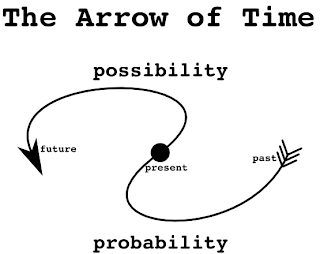
here.Suffice to say at this point, the Kingdom of God; the "arrow of time," and a classically Jewish and George Ladd-influnced eschatology are all elements of time travel. We have, the writer of Hebrews summarizes--almost in passing!... "already in our time and age tasted the powers of the future time and age to come."
As a pusher of buttons, and stretcher of norms/forms in my teaching, I recently challenged a class to finish the sentence "The gospel message is..."
Of course, as card-carrying evangelicals, most responded with the "obvious" right answer: "Jesus Christ died on the cross for my sins, so that iIcan go to heaven when I die."
I'm not saying that is the wrong answer.
But Jesus is.
Of course, as a statement, it is fact and true; and essential.
But as Dallas Willard reads the Bible, he finds:
"..the Gospel is not that Jesus died on the cross for your sins so you can go to heaven when you die, but that the Gospel that Jesus preached was the Gospel of the Kingdom. When you say this to people they look at you like you’re insane. ‘Of course the Gospel is that you can go to heaven when you die’, they say. But the Gospel isn’t a one-time event, it’s a daily participation with Christ in the Kingdom life.”
I
nterview with Dallas Willard in RELEVANT Magazine(read it all here)
Christ himself clarified taht it was the "gospel of the Kingdom" (Matt.) that is to be preached; and "The Kingdom is at hand" is his own definitive mission (Matt 4:17) . Note well that Willard, highly relevant to the time travel topic at hand, says the gospel is decidedly "not a one time event". If it's not one-time, it's mult-time. It's trans-time, it's multiple time; so, heck, it is by definition, design and default:
Time Travel.
That's the only way one can be two places at once.
Like I was this morning, in unkowing time machine of a 1999 Toyota Corolla, transported and trainspotted by a novel (remeber; Wang is correct: all art..including novels that are and aren't "about" time travel...
are time-travel) .
Once in awhile, I get a kick perusing the headlines of websites devoted to the topic of, and forum-posting about, time travel. One posting "Hi, I am Jesus Christ from the year 0 B.C."
Of course, the dead-giveaway that this was a phony was the '0 B.C.' time stamp. I didn't click to read his message (Hope I was right (:.....) But it got me thinking: Jesus is, in a sense, always traveling across time (whether you perceive it as travelling forward in time from his earthly human years; or "backwards" in time in Hebews 6
"visiting from the future heavenly Kingdom" mode), to give
us in our time a message. He mujs be a Time Traveller; he claimed "Before Abraham was, I am."
So his message/gospel/timeless news must be the same as it always was and will be:
As he travels from eterenity into time, time to time..
"The gospel is not a
one time event. It's a dynamic Kingdom."
R
ELEVANTmagazine.com:"Why did you write The Secret Message of Jesus?"Brian McLaren: "About 15 years ago I was having lunch with a very well-known Christian leader and author and he said to me, "You know Brian, most evangelicals don't really know what the gospel is." And I remember thinking, "Well that's a provocative statement," and I just sat staring into my hot and sour soup, trying to dodge his question. Then he continued, "For example, what do you think the gospel is?" And I gave him my best answer ... I talked about justification by grace through faith and the atoning work of Christ on the cross ... Then he said, "Well that's exactly what most evangelicals think." I came back with, "Well, what do you say the gospel is?" and immediately he answered, "Shouldn't we let Jesus define the gospel for us? For Jesus, the gospel is 'the kingdom of God is at hand.'"
And I remember thinking that he's probably a heretic. But it just stayed in my mind for all these years ... that for Jesus the gospel is that the kingdom of God is at hand. And in the last few years it's just become clearer and clearer to me that it's something that we should be paying attention to. The Gospel is The Kingdom. The Kingdom is, at heart, time travel.
The "paradigm shift" that many of us in church are finding ourselves in (defining, and living, the gospel as far bigger and broader than the individual salvation transaction; but as a "Kingdom thing" was called to mind in a powerful parallel in this morning's novel. As the main character, Reid Melenfant, calls a stakeholders meeting of his company to defend and sell his vision...perceived as quixotic by some...of colonizing space, he 'preaches'/'evamgelizes' (not just to the board; but on a whole nother level, to himself):
"If we start NOW, we may just make it. If we leave it any longer. we may not have a planet to launch our spaceship from."
"And," he said, "in the end, have faith."
"In who? You?"
Melenfant smiled.
His speech was well-rehearsed, and it almost convinced him. But Corelius's stuff nagged at the back of his head. Was all this stuff, he exploitation of the solar system for profit, really to be his destiny? Or--something else, something he couldn't yet glimpse (the saving of the human race)?
He felt his pulse race at the prospect.
(63)
You have likely seen the parallel. Melefant is "us": pastors and leaders in this curent shift. Cornelius (interesting choice of a ...biblical...name) is the Dallas Willards.,the Brian McLarens; (and more importantly, Jesus!) who call us to a grander, more cosmic, more altruistic and truer gospel message. As opposed to the one we all learned in Sunday School and seminray; the evangelical "right answer." Which is true, but not the whole Kingdom . In our accidental (?)
edificationolatry; we have gotten the point (or one of them), but missed and dissed the bigger picture.
Like Reid Malefant, "our speech ("The gospel is that Jesus died for your sins, so you can go to heaven when you die, yada yada") has been well-rehearsed; and we've almost convinced ourselves. "
This revelation from a "secular" novel is devastating.
The author, in a minor but intriguing plot twist, quotes the journal of an unnmaed future citizen, dated 2198 A.D.:
"It seems we are a generation doomed to live in the end time... And where is the relevance of the Christian mythos for us, whom God has abandoned?The relevance is in the character of Mary, Mother of Jesus....The Son abandoned His Mother....So today, we rehect the grandiose and selfish ambitions of the Son ...For we, too have been abandoned. We draw strength from Mary's dignity in betrayal. We are no longer Christians.We are Marians. Let us pray.
(p. 459)Thank God for excellent books in recent years, most recently
Scot McKnight's wonderful, "The Real Mary: Why Evangelical Christians Can Embrace the Mother of Jesus"...ht, that call e
But what they are not saying is "Jesus let his mother, and all of us down." Or "We are Marians." Unless that means taking hold of Mary's primary advice:
"Whatever Jesus tells you to do, do it!" (John 2)
That is the gospel/Kingdom/Trans-time message.The future has invaded the present time, as George Ladd and John Wimber often phrased it.
That's time travel.
We have already received the long awaited "Feyman radio transmission from the future." In answer to Jesus' prayer, the Kingdom is now proleptically and prophetically "come...on earth as it is in heaven"; in the present as it already is in the future.
Several other parts of teh book are worth mentioning. Tellingly, Cornelius, the visionary genius (apostle-prophet) who encourages (Pastor) Reid Malefant to preach and incarnate this more dynamic and eternal gospel, is on staff at a company named "Eschatology" On a lighter note, the reigning sodapop product of the future is unflichingly called in the book , as a brand name....well, the four-letter "S" word that it already is in our day! A great jab at "pop" culture (literal "pop" culture as well...
groan!)
But it was in the portayal of the future NASA...as an old wineskin/old guard, dream-denying top-heavy hierarchy (read "modern-church"..hello?), as opposed to the dream-freedom of quirky but visionary folks (Reid et al) who saw ways to do "ministry" in a more oraganic, less expensive and far more expansive faithful ways (read "emerging church") that really spoke to me. At one point, a former Apollo astronaut tapes an infomercial defending the apparently crazy and quixotic quest of the "independent, but relationally networked, and accountable to apostolic oversight" Reid to launch missions into space and time; even when at odds with the "denomination"/organization (NASA) that had "always done it a certain way." Part of the transcript of the infomercial is relevant here:
"F0r awhile it looked like something revolutionary would be done.. But then came the assasination attempt, and Cold War issues.
The president left space (and time travel) to other people, who couldn't get it done. NASA won its turf wars. But the dream ..none of that has gone away. Which is why I am fully behind Reid Malenfant's launches from the Mohave.
You just know those federal paper pushers were going to find every way they could to block him . "
(247)I have seen no more apt and articulate description of what I have seen first hand of denominational executives. It may well be unintentional for most, but they fall into "federal paper pushing. Eugene Peterson tells the most amazing, tragically true, and hilarious tale of "federal paper pushers I have heard. It must be read; yesterday, if possible (time travel, eh?). It's at
this link...and is side-splittingly funny, until the punchline lands with Pastor Peterson's casual:
"The institution has its necessary and proper place. I could not function well without it, maybe not at all. But I was quite mistaken to look for spiritual nurture and expect vocational counsel from it."
I must view life, faith, ministry and Kingdom from an organic, caring, Kingdom-future based time-travel kind of paradigm.
Even Shakespeare saw this.
!
Prospero's question in the Tempest:
"What seest thou else in the dark backward and abysm of time?"
The answer: Everything.
It's the only lens I have on the secrets of the Kingdom.
But if Peterson is correct that institutions can't care; even if they have a proper place in God's sovereignty; let's come full circle. We began with a Jewish mystic helping us re-imagine sabbath, even life, as sanctification of time; time (not space or real estate..even Temple Mount, or Protestant sanctuary) as our only and virtual and really virtual, time-travelling "cathedral". Let's now trace the tracks of John Whitehead (a writer I don't follow down all his trails..he can be too reductionist and reactionary for me), as he wonders aloud (or should based on his research) if it is religious institutions (NASA, denomimations, The Matrix, etc) that have been the primary bandit behind our current dilemma: a church that doesn't "get" time; let alone relationship.
Religion may be the most "secularizing force" in all history, Whitehaed boldy allows; particularly the religious instiution that "baptized" clock time; at the great expense of the intended outcome (kairos and Kingdom):
monasteries!
Whitehead, in a section of "The End of Man," captioned: "The Time Machine" :
"A tool or a machine (any form of technology) is a constituent of man's symbolic recreation of his world. Moreover, machines that have been owned and operated by only a few members of a society have often influenced the entire society.Movable type, for example, completely altered, within a relatively short time, the entire concept of medieval man and socoiety. As McLuhan notes in 'Gutenberg Galaxy.":
Printing from movable types created a quite unexpected new environment-it created the PUBLIC. Manuscript technology did not have the intesnity or power of extension necessary
o create publics on a national scale. What we have called "nations" in recent centuries did not, and could not, precede the advent of Gutenberg technology any more than they
can survive the advent of electric circuitry with its power of totally involving all people in all other people...The unique character of the 'public' created by the printed word was an intense and visually oriented self-consciousness, both of the individual and the group.
There is, however, probably no better illustration of technology altering Western culture (and eventually, the world) than the invention of the clock.
Before the clock, and until darwin's theory of eveoilution began to sink into the stream of commly held ideas, peple knoew that the world about themm--the world of reproducing plants and animals...-has always exisited, and that its fundamental law was eternal periodicitry. Cosmolological time,a s well as the time perceived in daily life, was sort of a complex repeating and echoing of events. Howeber, with the emergence of the clock and its sudden position of dominance dutiong the Industrial revolution, a transformation in man occurred. Instead of merely living in the natural world he became, nautures alleged master.
Lewin Mumford calls the clock, not the printi g press or steam engine 'the key machine of the moerrn industrial age.' In his 'Technics and Civilization,' he desribes how during the Middle Ages the ordred life of monasteries affected life in the communities adjacent to them:
The monastery was the seat of a regular life...The habit of order itself and the earnest regulation
of time-sequences had become al,ost second nature in teh mosatery...The mosareries--at one time there were 40,000 under the Benedictine rule -helped to give human enterprise the regularcollective beat and rhythm of the machine; for the clock is not merely a means of keeping track of the hours, but of synchronizing the actions of men....By the thirteenth century there are definite records of mechanical clocks of mechanical clocks, and by 1370 a well-designed "modern" clock had been built by Heinrich von Wyck at Paris. Meanwhile, bell towers had come into existence, and the new clocks, if they did not have, till the fourteenth century, a dial and a hand that translated the movement of time into a movement through space, at all events struck the hours. The clouds that could paralyze the sundial...were no longer obstacles o time-keeping: summer or winter, day or night, one was aware of the measured clank of the clock. The instrument presently spread outside the monastery; and the regular striking of the bells brought a new regularity into the life of the workman and the merchant. The bells of the clock tower almost defined urban existence. Time-keeping passed into time-serving and time-accounting and time-rationing. As this took place, Eternity ceased gradually to serve as the measure and focus of human actions.
-John W. Whitehead, "The End of Man," pp. 112-13
The very sabbath keepers instititutionalized and secularized sabbath "on their clock," but now it's on ours. I will leave the appropriate analysis of the more recent analog to digital shift in culture, church, and consciousness to great thinkers like Phil Brewer and Jordon Cooper. And I am thrilled we have some budding "sons of Isachar" ("They knew the times; and this what God's people should do," 1 Chron 12:32) in our day: Shane Hipps and others in the line of Sts. McLuhan and Ong. May that tribe increase.
For now, I am thanking God for insights gleaned from a "secular" scientist and novelist who has me wondering if I don't need to spend more time (quality annd kairos time) in my 1999 model time machine...losing track of tme in that Toyota; ignoring it's digital clock;
and keeping the sabbath holy..


 Once, in


![[spnya69508244_1569953_4434.jpg]](https://blogger.googleusercontent.com/img/b/R29vZ2xl/AVvXsEi6XgPNNwjcR7Ae-ePyqBcTuiWfaJs52M6pAfW_CGF2NhsSanYgsORIN74IEApp1WRd3OB69LAgH1p_JEX92hfkVWYDNKMz-Jpq2FGsUEmwoo1mb7Ddi4ykt_Cs89E1GH742TIm/s400/spnya69508244_1569953_4434.jpg)


