Channel:
https://www.youtube.com/@DiscipleDojo
Showing posts with label apocalyptic. Show all posts
Showing posts with label apocalyptic. Show all posts
Friday, March 21, 2025


Tuesday, December 08, 2015
"The last days ended with Pentecost." -Mark DeRaud

Of course, I have taught that according to Joel 2/Acts 2, the last days began at Pentecost.
Peter preaches, and says "What you see is the following; "In the last days....I will pour out my Spirit.."
14 Then Peter stepped forward with the eleven other apostles and shouted to the crowd, “Listen carefully, all of you, fellow Jews and residents of Jerusalem! Make no mistake about this. 15 These people are not drunk, as some of you are assuming. Nine o’clock in the morning is much too early for that. 16 No, what you see was predicted long ago by the prophet Joel:
17 ‘In the last days,’ God says,
‘I will pour out my Spirit upon all people.
Your sons and daughters will prophesy.
Your young men will see visions,
and your old men will dream dreams.
18 In those days I will pour out my Spirit
even on my servants—men and women alike—
and they will prophesy.
19 And I will cause wonders in the heavens above
and signs on the earth below—
blood and fire and clouds of smoke.
20 The sun will become dark,
and the moon will turn blood red
before that great and glorious day of the Lord arrives.
21 But everyone who calls on the name of the Lord
will be saved.’[c]
‘I will pour out my Spirit upon all people.
Your sons and daughters will prophesy.
Your young men will see visions,
and your old men will dream dreams.
18 In those days I will pour out my Spirit
even on my servants—men and women alike—
and they will prophesy.
19 And I will cause wonders in the heavens above
and signs on the earth below—
blood and fire and clouds of smoke.
20 The sun will become dark,
and the moon will turn blood red
before that great and glorious day of the Lord arrives.
21 But everyone who calls on the name of the Lord
will be saved.’[c]
But Mark's comment (based on the Walt post) pushes a huge envelope:
"The last days ended with Pentecost." -Mark DeRaud.
What do you think?
This raises the question about whether verses 19-20 have happened yet?
Of course, the party line is that the sun darkening and the red moon are signs of the "end of the end, "and they obviously haven't happened yet. Yet many including NT Wright make the case that this was a symbolic way of speaking of the events of AD 70: destruction of the temple. (see what Wright does with the Isiaah 13:10 sun and moon signs here. See also a couple posts by Kirk
here and here ).
Mark, your take on that? Do you see the sun/moon signs as Pentecost, or about the tumultuous transition to the New Covenant order"? Or..
King's post:
Why We Might Not Be Living In The "Last Days"
I was talking with a well-meaning leader just the other the other day who began discounting my outlook. He said, "J.D., your view is preposterous. Don't you notice how terrible things really are? Don't you know what the Bible says? 'There will be terrible times in the last days'" (2 Timothy 3:1).
Another man suggested that I was a "scoffer." He said, "Don't you know what Jude, the half-brother of Jesus declared, 'In the last times scoffers will arise who will follow their own ungodly desires' (Jude 1:18). If you don't see things getting worse, you're nothing more than a scoffer - rejecting the Word of God."
Many insist that the Bible foretells disaster and trouble - particularly as we descend into the "last days." They're convinced that, in the grand biblical narrative, cataclysm and destruction are imminent. It seems that there can be no goodness or hope in "perilous times."
This kind of worldview is understandable. A superficial reading of the New Testament would suggest the reality that they're asserting. However, things are not always as they appear.
The term "last days" is arguably one of the more misunderstood phrases in the Bible. It is not talking about the end of the world, but the end of the “old covenant” era.
Rather than referring to the destruction of the earth, it is a depiction of the end of the temple, animal sacrifices, and Levitical priesthood. It spoke of the unrest and volatility that would be found at the cessation of a religious order that was, at best, temporal in nature (Hebrews 6:20-8:13).
It might surprise many to hear this, but the writer of Hebrews affirms that the last days were in his lifetime. He declares that the revelation was being received, "in these last days" (Hebrews 1:2). Elaborating on what this meant, he goes on to declare that "Jesus has now obtained a more superior ministry, since the covenant he mediates is founded on better promises" (Hebrews 8:6).
The “Last-Days” or “End of the age” is really about the tumultuous transition to the New Covenant order. It is the end of what was and the beginning of something new! It was never meant to be used as an excuse to sidetrack the good news of the gospel. link
Tuesday, November 03, 2015
"lead us not into the coming birth pains.."
Both images from the Andrew Perriman post on What does Jesus mean when he teaches his disciples to pray “lead us not into temptation”?

 |
| "The Temptation of Anthony" |

Wednesday, October 07, 2015
Jesus' surprising answer to "Where did all of these people go?": More on leaving behind Left Behind
of course Christians will be left behind

of course Christians will be left behind
of course Christians will be left behind
As a followup to the post, "Of course, Christians will be left behind," which looks at Matthew 24 "left behind" passage with NT Wright and Barbar Rossig..
of course Christians will be left behind NT Wright and Barbara Rossing..
Here's Benjamin Corey, who builds the case from Luke:
Jesus Says Those “Left Behind” Are The Lucky Ones (the most ironic thing the movie won’t tell you) by Benjamin Corey:
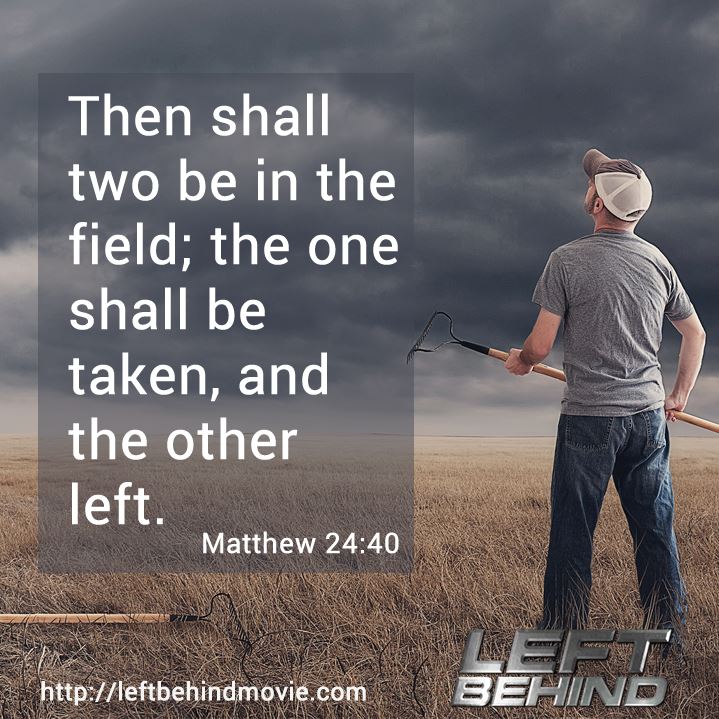
In
the lead up to the release of the remake of Left Behind hitting
theaters in a few weeks, I wanted to take a moment to tell you about the
most ironic thing the Left Behind movie (or rapture believers) won’t
tell you about getting “left behind.”
The
basic premise of the theology is this: the world is going to get
progressively worse as “the end” draws near. Before the worst period of
time in world history (a seven year period called the “tribulation,”
though there’s no verse in the Bible that discusses a seven year
tribulation) believers in Jesus are suddenly snatched away during the
second coming of Christ (which rapture believers argue is done in secret
and without explanation, instead of the public second coming described
in scripture).
The entire premise of
the theology and the Left Behind movie is based on a passage from
Matthew that you’ll see in the official Left Behind image included to
your left. The passage states:
“Then shall two be in the field; the one shall be taken and the other left”.
And this is where we get the term “left behind”… Jesus said “one shall be taken and the other left.”
Pretty
simple, no? It appears from this passage that Jesus is describing an
event where some people actually do “get taken” and the others are “left
behind.” It must be a rapture then.
Or maybe not.
As
I have explained before, the chapter of Matthew 24 is a chapter where
Jesus describes the events that will lead up to the destruction of the
temple which occurred in AD 70. That’s not so much my scholarly opinion
as it is what Jesus plainly states in the first few verses of Matthew
24; it is a context pretty difficult to explain away since Jesus says
“this temple will be destroyed” and his disciples ask, “please, tell us
when this will happen.” The rest of the discourse is Jesus prophesying
the events that will lead up to the temple’s destruction, which we know
historically unfolded as Jesus had predicted. (As I have alluded to in What Jesus Talked About When He Talked About Hell and Don’t Worry The Tribulation Is In The Past,
if one does not understand the significance of the destruction of the
temple to ancient Judaism, one will have a very hard time understanding
what Jesus talks about when he talks about “the end.”)
Anyhow,
during the end of this discourse in Matthew we hit the “rapture” verse:
“one will be taken and one will be left.” Surely, this part must be
about the future, and Jesus MUST be describing a rapture. Since that’s what my childhood pastor taught me, it’s probably a good idea to stick with that.
Just
one problem: Matthew 24 isn’t the only place where Jesus talks about
“some being taken and some being left behind.” Jesus also discusses this
in Luke 17 when he says:
“I tell you, on that night two people will be in one bed; one will be taken and the other left. 35 Two women will be grinding grain together; one will be taken and the other left.”
Building
a compelling case for the rapture yet? Not quite. Check this out:
Jesus’ disciples in the Luke version of the discourse must have been
interested in this left behind stuff, because they ask a critical
followup question. However, they actually seem more concerned with those
who were “taken” than those who were “left behind” and ask Jesus for a
little more information on this whole getting taken away stuff.
“Where, Lord?” is the question of the disciples. Where did all of these people go??
If
this were a passage about the “rapture” as depicted in the Left Behind
movie, one would expect Jesus to answer something to the point of “they
were taken to be with me to wait out the tribulation.” But, that’s not
what Jesus says. Instead, Jesus gives them a blunt answer about those
who were “taken”: “just look for the vultures, and you’ll find their bodies.” (v37)
That’s right. The ones who were “taken” were killed. Not exactly the blessed rapture.
The
Roman occupation was brutal, and when they finally sacked the city and
destroyed the temple in AD70, things got impressively bloody. To be
“taken” as Jesus prophesied, was to be killed by the invading army. This
is precisely why, in this passage and the Matthew version, Jesus gives
all sorts of other advice that makes no sense if this is a verse about
the rapture. Jesus warns that when this moment comes one should flee
quickly– to not even go back into their house to gather their
belongings– and laments that it will be an especially difficult event
for pregnant and nursing mothers. He even goes on to warn them that if
they respond to the army with resistance (the very thing that causes the mess in the lead-up to AD70),
they’ll just get killed (“whoever seeks to save his life will lose
it”). Jesus, it seems, wants his disciples to get it: when the Roman
army comes, flee quickly or else you might not be left behind!
Surely,
Jesus is not talking about a rapture. He’s not warning people to avoid
missing the rapture because they went home to get their possessions…
he’s talking about fleeing an advancing army and not doing anything stupid that will get them killed (v 30-34).
Very
practical advice for his original audience and would have come in handy
for those who wanted to avoid being “raptured” (slaughtered) by the
Roman army.
And so my friends, this is the most ironic thing the Left Behind movie won’t tell you: in the original “left behind” story Jesus tells in the Gospels, the ones who are “left behind” are actually the lucky ones.
So
the next time folks tell you that they don’t want to be “left behind,”
you might want to tell them to be careful what they wish for. -Benjamin Corey, link
of course Christians will be left behind
--
Adam Maarschalk adds some evidence from sources in 1700s and 1800s:
In our study of Matthew 24:36-51, I also proposed that Jesus said it would be better to be “left behind” than to be “taken,” and noted that 2-3 centuries ago this was taught by John Gill (1746-1763) and Albert Barnes (1834). Benjamin Corey does an excellent job showing the revealing connection between what Jesus says in Luke 17 and what He says in the more frequently quoted Matthew 24:40. His article also comes at a good time, less than two weeks before the remake of the Left Behind movie hits the theaters on October 3rd. Hopefully the theology in this film will soon be left behind by many followers of Christ. link
Saturday, July 11, 2015
Which Dave Matthews?: "as horny as Lil Wayne" and/or as Godhaunted and apocalyptic as anybody?

Man, could he pray through his guitar (with "palpale holiness")..even if he didn't believe in God.
More recently, RS has suggested that Dave Matthews is
one of rock's most underrated Pretty Complex Dudes – as horny as Lil Wayne, as troubled as Thom Yorke, able to growl "war is the most vulgar madness" like the American Sting he's always sort of been. He's got a beige-Baja-shirt rep and a black-turtleneck soul. -linkGreat point, since as Mr and Mrs David Dark have masterfully noted Yorke (and his Radiohead) are absolutely apoclayptic and "very resurrection." (Back to Zappa, Rolling Stone, in the link above, Joe’s Garage is Zappa’s Apocalypse Now.)
We apparently have the word “apocalypse“ all wrong. In its root meaning, it’s not about destruction or fortune telling; It’s about revealing; It’s what James Joyce calls an epiphany-the moment you realize your so-called love for the young lady, all your professions, all your dreams, and all your efforts to get her to notice you were the exercise of an unkind and obssesive vanity…The real world, within which you’ve lived and moved and had your being, has unveiled itself. It’s starting to come to you. You aren’t who you made yourself out to be. An apocalypsehas occurred, or a revelation, if you prefer…Apocalyptic maximizes the reality of human suffering and folly before daring a word of hope. The hope has nowhere else to happen but the valley of the shadow of death. Is it any surprise that we often won’t know it when we see it?
-David Dark, “Everyday Apocalypse: The Sacred Revealed in Radiohead, The Simpsons and Other Pop Culture Icons”, p.10
One heteroclite has suggested/joked that half of Dave's songs are about God, and half are about sex...
....and maybe even the sexsongs are eventually Godsongs (or is it vice versa?)
Makes sense; as Rob Bell says in "Sex. God.,' "This is about that"
How do you hear/read/experience/interpret Dave Matthews?
Some deep meditations/prayers/laments about and to God (or "God as a symbol"):
- Dave Matthews on God....and monkeys
- Dave Matthews: "when i get home/i wanna believe in Jesus"
- Godhaunted Dave Matthews: Bartender and The Maker
Then check out these links ....click at own risk, NSFC (:
Sunday, June 28, 2015
Most Misinterpreted Bible passages (Jason Staples)
From Jason Staples..
click a link to read an individual post, or here to see all.
Introduction to the series here
“
- Whoever Looks at a Woman With Lust”: Misinterpreted Bible Passages #1
- “Judge not, lest you be judged”: Misinterpreted Bible Passages #3
- “The Signs of the Times”: Misinterpreted Bible Passages #5
- “Pearly Gates” and “Streets of Gold”: Misinterpreted Bible Passages #2
- A Bald Man, Two Bears, and Forty-two “Children”: Misinterpreted Bible Passages #6
- “That day will come like a thief”: Misinterpreted Bible Passages #4


Tuesday, January 13, 2015
"Why you WANT to be left behind"

Here on his podcast he interviews James-Michael Smith..an awesome missionary
to and from the US (:
Topic: "Why you WANT to be left behind."Listen here
Related:
Tuesday, November 04, 2014
on earth now...as it is on heaven

but it's Rich Kriegbaum:
“If nobody is lonely and abandoned in heaven,
then I want everyone to have good and faithful friends here on earth now.
If no one is hungry in heaven,
then I want the hungry fed good nutrition on earth now.
If nobody is controlled by addictions in heaven,
then I want bodies, minds, and souls liberated to freedom in Christ here and now, on earth.
If there is no violence or war in heaven,
then I want peace and reconciliation among people here on earth now
If heaven has clean air and water and no cancer,
then I want clean air and water and no cancer on earth now as it is in heaven.
If everyone in heaven is a joyful follower of Jesus Christ, worshiping him in spirit and in truth,
then I want everyone on earth to experience the love of God and joyfully follow the King of Kings and worship the prince of peace in spirit and in truth.”
Watch this talk here
Wednesday, September 10, 2014
Blake on ecclesiology, profane becoming sacred, and thinking against oneself
It's kind of freaky that just a few days ago--before you and I had any idea that U2's surprise releases
would be called "Songs of Innocence" and "Songs of Experience"..
..I pulled out two books:
I would, however, reverse the figure and the field. Blake does not celebrate the sacred
becoming profane, but the profane becoming sacred.
would be called "Songs of Innocence" and "Songs of Experience"..
..I pulled out two books:
- Blake's "Songs of Innocence and Songs of Experience"
- Inchausti's "Subversive Orthodoxy
One theory is that "The Joshua Tree" was to be a double album; one disc "Songs of Innocence" and the other "Songs of Experience".
One reviewer headlined a review of U2's "Pop" as More Songs of Innocence and Experience.
One can see why Bono likes Blake. From Inchausti:
If one were to seek the great archetypal precursor for prophetic Christian thinker championing the soul's return from the spiritual exile of Enlightenment rationalism, William Blake comes very close to casting the mold. Condemned as heretical by some and as too orthodox by others, he was one of the first to point out exactly how the new sciences were distorting the role of the imagination in human affairs and putting the soul to sleep.Altizer and Hamilton..described Blake's contribution to Western thought
This, I think, is an essentially accurate description of Blake's intellectual influence.Blake was the first of the modern seers. Through Blake we can sense the theological significance of a poetic reversal of our mythical traditions, and become open to the possibility that the uniquely modern metamorphosis of the sacred into the profane is the culmination of a redemptive and kenotic movement of the Godhead
I would, however, reverse the figure and the field. Blake does not celebrate the sacred
becoming profane, but the profane becoming sacred.
....Blake reminds us again and again that true knowledge--that is to say, knowledge of our ontological status as creatures made in the image of God--cannot be grasped by calculation; only through a vision. And vision--in its most concentrated and inclusive firm --is what psychoanalysts call the "imago," an internal picture that transform s facts into meanings..
..His theme is that the church lost its radical energy by giving up its apocalyptic vision for a more accommodating set of doctrines, and so the church became more hierarchical and tradition-bound at the very moment it should have become more democratic and imaginative..
Christian thought critiques mainstream culture but also sees itself under judgment; our best modern Christian intellectuals have turned thinking against themselves into a veritable art form: from Blake to Dostoyevsky, from Kierkegaard to Chesterton, all the way to Dorothy Day and Walker Percy, the exemplary mode of Christian thought has been a triadic structure of self-reflection, paradox and irony that reverses the values of this world and the logic of cause and effect pp 19-28, 178
Monday, July 28, 2014
church as a nonhectic, episodic event which fractures time
.jpg)
..The Kingdom is, I believe, temporal as much as spatial...the event of the church constantly, repeatedly fractures time. This is to say, the church as an institution or nation is, first of all, an event of the moment, gathered here or there, but that does not predetermine whether or how the church will appear again. The church is episodic in history; the church lives in imminence so that the church has no permanent locale or organization which predicates its authenticity as the church. This may seem a hectic doctrine of the church to the Constantinian mentality. It is. But it is so because it suggests the necessity of breaking away from Constantinian indoctrination in order to affirm the poise of the church awaiting the second advent of Jesus Christ. .. William Stringfellow, Conscience and Obedience: The Politics of Romans 13 and Revelation 13 in Light of the Second Coming. (ht, Richard Beck)
Tuesday, January 28, 2014
more proof that power point is from hell..even when presenting news from heaven
Paul's powerpoint to the Corinthians:
Related:
Power Point is From Hell...or at least from Modernity)
Power Point is From Hell...or at least from Modernity)
nudist haidresser guitar player sneakily videotapes an out-loud temple tantrum for all nations with Power Point
Review: "Off-Road Disciplines":Rules for Power Point
Monday, December 16, 2013

Sunday, November 17, 2013
Brueggemann on Rev. Billy's prophetic guerilla theatre against Shopocalypse
 Brueggemann: "What Would Jesus Buy?" excerpt:
That day Starbucks was busy but quiet. People were relaxed and talking, sipping $6 venti lattes. Then there was a phone conversation, readily heard by the sippers, about being in the wrong Starbucks and missing each other. There was another cell phone call, this one raising the question of buying all the “extras” sold by Starbucks. Soon two more calls occurred over the same issue—then a dozen calls, enough to disrupt the entitled relaxation. Finally there was a disturbing hubbub and the phone-callers shrieked with joy and celebratively removed themselves from the shop, to the great relief of management.
It was a prophetic disruption by the Church of Stop Shopping, a fairly typical enactment of “guerrilla theater” by the folks around Rev. Billy, a dramatic performer of prophetic faith.
Reverend Billy, also known as Bill Talen, has gotten the strange idea that the Big Corporations, notably Disney, Starbucks, Nike, and Wal-Mart—and their shameless commitment to profit at the expense of human infrastructure—constitute a destructive force in our society. He has, moreover, reached the critical judgment that such a negative ideological force in our society must be resisted, and can best be resisted from a self-aware theological perspective that operates with parody and irony. The purpose of such parody and irony is to expose what seems like an economic operation as an ideological force of totalizing scope in our society. This force seeks to situate U.S. consumers in an uncritical way in the “life world” of consumer capitalism.
The specific discipline that is expected and required by this corporate “life world” is endless shopping without reflecting on the needs of or obligations to the community that might curb patronage at such shops. That is, Rev. Billy takes these organizations (and many others like them) as agents of consumerism that has become a “consuming” ideology in our society. In the end that consuming ideology distorts not only social resources but eventually neighborhoods, practices of neighborliness, and social vision as well.
Thus the Church of Stop Shopping, Rev. Billy’s congregation, dispatches its members in protest against the Church of Shopping and engages in deliberate, sustained resistance to shopping as a way of participating in an alternative covenantal life.
AFTER HEARING HIS disc of preaching and music and reading his two books—What Should I Do If Rev. Billy Is in My Store? (The New Press, 2003) and What Would Jesus Buy? Fabulous Prayers in the Face of the Shopocalypse(Public Affairs, 2006)—I have no doubt that Rev. Billy is a faithful prophetic figure who stands in direct continuity with ancient prophets in Israel and in continuity with the great prophetic figures of U.S. history who have incessantly called our society back to its core human passions of justice and compassion...
It is the power of parody to call attention to the unstated but powerful intentions that are mostly kept hidden in advertising and public presentation. The parody of the prophetic regularly slides over into irony, in which things are renamed and re-identified so that their truth cannot go unnoticed.
,,,,Amos Wilder, the wise New Testament scholar of the last generation, observed that the parables of Jesus are a form of “guerilla theater,” action against settled conviction and an invitation to listeners to come “on stage” into the action. Before Jesus, this same guerilla theater was the enterprise of the ancient prophets. That theater continues with Rev. Billy. We are surely apt candidates for the Church of Stop Shopping. With enough new recruits for the action, perhaps we need not be subjected to the Shopocalypse. link , What Would Jesus Buy?
http://sojo.net/magazine/2007/11/what-would-jesus-buy
Related:
- Rev. Billy is running for mayor
Subscribe to:
Posts (Atom)