Showing posts with label sabbath. Show all posts

Thursday, March 01, 2012

Eugene Peterson video interviews on sabbath and scripture

With a quick sign in,, you can see  (for a limited time) two "Q Ideas" videos from Eugene Peterson

  • "Practicing Sabbath"
  • "Immersed in Scripture"
here or
here.

Monday, February 06, 2012

That's Wright, you stud: Jesus is New Moses, Neo Victor, and reshaper of space, time and matter

=

I simply haven't even started "Simply Jesus" yet. (I know, simply no excuse).


Three emphases stand out for me  already from Scot McKnight's series of posts  and I will post a review after reading it on the plane today (pray for a quiet trip, such don't always happen).

1) The evocation and invocation of seven Exodus themes as central to Jesus'  message ministry as New Moses::


  • tyrant
  • leader
  • divine victory
  • sacrifice
  • vocation
  • divine presence
  • promised inheritance.
image source
BTW, is this (simply) a sequential narrative with seven "stops," or can it  (also) be

a seven-Venned  (see this schema) which can be hermeneutically entered anywhere?


See Scot McKnight:

The major themes of the Exodus are at the heart of Tom Wright’s new book Simply Jesus: A New Vision of Who He Was, What He Did, and Why He Matters. But there’s more to say than that: Exodus is at the heart of the entire mission of Jesus. Because this Exodus theme is both cut up into its seven segments (more below) and because Exodus becomes more central, it is fair to say that Simply Jesus takes us beyond Tom’s well-known Jesus and the Victory of God. He puts it all together in this book….

First the seven Exodus themes are tyrant, leader, divine victory, sacrifice, vocation, divine presence, and promised inheritance. This is at the heart of this book.

Second, Tom sketches how three absolutely crucial (to Jesus and to the apostles) figures of the Old Testament illustrate these seven themes and therefore are instances of carrying forward the Exodus project. The three figures are the Servant of Isaiah 40-66, the Son of Man of Daniel 7, and Zechariah’s king, esp as found in the last half of Zechariah. You will have to take my word for it that he has given us an important sketch of exodus themes here.

Third, now the big one: Jesus’ mission is shaped by those same themes, and so I want to quote from what I think is perhaps the crucial paragraph in this whole book. Remember: it’s Exodus, Exodus from Moses through Isaiah, through Daniel, through Zechariah, and now reshaped and reconfigured for a new day in a new way by Jesus — the three-fold storm converging: Rome, Jewish leaders, and the new message about God becoming king in and through Jesus -link:Simply Jesus 4
Neo Jesus 2)Related, Richard Beck picks up on the Christus Victor (which I can never envision without thinking of Neo/Keanu)  connection:

A lot of people are listing N.T. Wright's recent book Simply Jesus on their "Best Books" lists for 2011. I agree, it's a great book and a lot of the book nicely supplements the work we've been doing in this series, particularly the work with Christus Victor theology. Recall, in the last few posts we've been thinking about the role of "the satanic" in human relations through the work of Walter Wink and William Stringfellow (and earlier in this series the Church Fathers and Eastern Orthodox theology).

What is the book Simply Jesus about? Simply stated (he he!), the book is trying to get into the head of Jesus. What did Jesus think he was doing during his life and ministry? How did he see himself? How did he envision his task? That's the question the book starts off with. The very opening lines:
Jesus of Nazareth poses a question and a challenge two thousand years after his lifetime. The question is fairly simple: who exactly was he? This includes the questions, What did he think he was up to?...
You'll have to read the book to find out all the in's and out's of the answers to that question. What I'd like to do is underline the Christus Victor themes from the book that supplement and reinforce what we've been talking about in this series. Specifically, Wright argues, rightly in my opinion, that Jesus primarily saw himself as doing battle with the devil.
1 John 3.8b
The reason the Son of God appeared was to destroy the devil’s work.
This conflict was framed by the Second Exodus expectations that Jesus invoked as he described his life and ministry. As Wright describes it, the Exodus story had seven themes:

  1. Wicked tyrant
  2. Chosen leader
  3. Victory of God
  4. Rescue by sacrifice
  5. New vocation and way of life
  6. Presence of God
  7. Promised/inherited land
By invoking this story, in announcing the inauguration of a Second Exodus, Jesus uses the seven themes (the Exodus narrative/paradigm) to describe his own life, teachings, and eventual death and resurrection.

So the question becomes who is the "Wicked tyrant"? Who is playing the part of Pharaoh in Jesus's dramatic retelling of the Exodus?

For a lot of the Jews Rome and Caesar would have been the obvious contender. But as we know, Jesus didn't say much of anything about Roman occupation and oppression.

So who is Pharaoh?

Well, this is where the Christus Victor themes come in. Here is Wright, after many chapters working through New Exodus material, finally turning to the battle with the Wicked tyrant....
         -Continued at "The Slavery of Death: Part 18, N.T. Wright on Christus Victor"

--
3)Again, related to the point above, and riffing off it:

  The "temple tantrum" passage is huge for me --particularly, what it was  fundamentally and microcosmically about;  and also its relationship to anger, battle and violence.  (I am inclined the believe the passage is the centerpoint of a "ripping" inclusio in Mark).  So I was thrilled to read this, from McKnight's series on the book, and find yet another of my favorite themes which is OBVIOUSLY(: and always  connected to the temple tantrum: the physics of time
 (Wright had been simply eading my mail.  I'll be retrurning the favor by simply reading his book )

It is Tom Wright’s contention, in his new book Simply Jesus: A New Vision of Who He Was, What He Did, and Why He Matters, that Jewish kingdom movements had two integral features: a battle and the temple. Tom examines those two themes in the Gospel records about Jesus.

First, the battle: “it was a different sort of thing, because it had a different sort of enemy,” and here Tom examines “the satan” in the Bible. There is so much battle with “the satan” in the records about Jesus that it has to be taken not only as an element but significant (Mark 1:13, 27, 34; 3:11-12, 22-27; 5:1-20; Luke 10:18; 13:16; 22:31; John 13:2, 27).  To be sure, we may struggle with this stuff but that doesn’t mean they (or Jesus) did. That battle seems to have two stages: an earlier stage (the Temptation) and a final victory. The satan’s victory is the cross, but the victory was not to last.

How central are the battle and the temple to most of our understandings of Jesus? How central are space, time and matter? Do you think these ideas are supersessionistic or continuous with Judaism?

Second, the temple. Here Tom focuses on the “cleansing of the temple,” which is really a royal declaration of God’s judgment on the temple and its authorities.


This leads Tom into one of the more creative portions of this book: Jesus reshapes space, time and matter. Tom’s big idea is that God is becoming king in and through Jesus as his earthly representative. The temple was the place where heaven and earth met, where God’s presence overlapped. But Jesus redefined space by contending God’s presence was wherever Jesus was. “Jesus was, as it were, a walking Temple” (133). That Temple was a signpost but now that God was present in Jesus, the Temple was coming to an end. It became redundant, it was criticized as a place of economic oppressions, and it was a place of violent ambition.

As for time. Sabbath was the place where God’s time and our time met with God’s temporal presence, and Jesus saw himself as superior to the Sabbath. He is the walking, celebrating, and victorious Sabbath.

And as for matter. Big one here: new creation renews matter. The key element of this is Jesus’ miracles. The material world is being transformed. Matter becomes a more visible glorious presence of God. Another important indicator of this theme: the transfiguration of Jesus in Matthew 17:1-8. -Link:Simply Jesus 3

N.T. Wright is simply a Bible Stud...unlike some wannabees (see pic)...and he simply would never stand in front of the 'Y"...

Tuesday, December 14, 2010

Wednesday, March 10, 2010

We need something longer and more nonsensical than Sunday church: Rohr on liminality

(photo credit: Feris's blog)

Often the question I wrestle with here on this blog/block is,
"What is God saying to us here about the role of the pastor in the current culture?"

(click the "role of the pastor" label at bottom of page to see all posts on that topic)

I often half-joke about new "titles" for "pastor" that help us refocus the role; and half-joke about including that on my next business card.

Reading Rohr allows me to still be a party planner (whew!),
but add on "liminal planner/liminoid exorcist"... jk (:


ROHR:

"Nothing fresh or creative will normally happen when we are inside our self-constructed comfort zones, only more of the same. Nothing original emerges from business as usual. It seems we need some antistructure to give direction, depth, and purpose to our regular structure. Otherwise structure, which is needed in the first half of life, tends to become a prison as we grow older.

Much of the work of the biblical God and human destiny itself is to get people into liminal space..it is the only teachable space. So much so that spiritual giants try to live their entire lives in permanent liminality. They try to live on the margins and periphery of the system... It can take the form of monks... [or those who]deliberately place themselves in risky situations, which is to displace yourself.

For most of us...once a week church services do not normally come close to creating liminal space....There has to be something longer, different, daring, even nonsensical..

..The bubble of usual order has to be broken by a bit of whimsy, holy uselessness, deliberate disruption or displacement, learning how to walk in the opposite direction..Forty days is probably a minimum period to spend in liminal space..

The most common substitute for liminal space is "liminoid space,"...Nothing new happens here, only a continuation of the old..Victor Tuner calls this ceremony, as opposed to ritual...We love ceremony, the limimoid, because it asks so little of us other than to show up...

.,,This is why...Jesus mistrusted acts of mortification, dietary laws, or any religion of heroics. They are usually liminoid instead of liminal. The Christian liturgical season of Lent is ideally forty days of practice at some form of liminality..They are structured liminal space..As the Jewish tradition brilliantly intuited: if at least one-seventh of life is not consciousness, presence and naked human BEing, the other six days will be caught up as human DOings that have little depth, meaning or final effect. If at least one -seventh of life is somehow Sabbath and sabbatical, the rest will take care of itself. Without daily, weekly and yearly choices for liminal space, our whole lives eventually become liminoid and we end up just doing time."
-Richard Rohr, excerpts from Chapter 12 ('All Transformation Takes Place in Liminal Spoace" ) of "Adam's Return: The Five Promises of Male Initiation."

Tuesday, November 10, 2009

the internet was made for man, not man for the internet

In a helpful post,"Can a Man Write Offline?," DreamerTom notes:


The internet does not lend itself to seasons. It cries out for constancy.
link
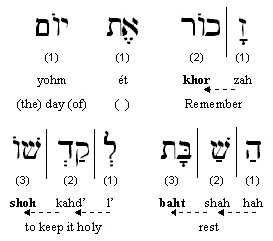


Thus we must discern and re-member the rhythms;
sneakily seek the seasons and sabbathings of the Spirit,
with insistent and consistent unrestraint
even when the sabbath doesn't fall on the sabbath.

Only random regularity and fixed fluidity will keep us on time and in sync,
deliver us from strategy,
and cast out every foul spirit of effectiveness
Who took the shabbat out of shalom?

Sometimes the only way online with God is offline with man.
And machine.

Ever seen someone online while in line for the shabbat elevator?

I love my friend Tony who has ditched his watch, and found his life.
Ironically it might be the only ways and means for me rememebering the sabbath.
Calendars lead to Chronolatry, anyway.
But missing and dissing sabbaticals lead to caving to Empire.


"If that's all we do (reduce everything to a problem to be solved, and fix and figure), we become myopic, managers and mechanics of what is immediately before us, with no peripheral vision and no horizons. We miss most of life." -Eugene Peterson"The Unnecessary Pastor,"

Friday, October 02, 2009

sabbath and re-creative creativity

TED TALK:

"Every seven years, designer Stefan Sagmeister closes his New York studio for a yearlong sabbatical to rejuvenate and refresh their creative outlook. He explains the often overlooked value of time off and shows the innovative projects inspired by his time in Bali."

Wednesday, March 25, 2009

i dont wanna talk about God...not right now, not on the sabbath

I think next time I take the sabbath elevator in Jerusalem,
instead of getting frustrated with the lack of speed and efficiency,
I will enjoy the leisurely (the whole point of sabbath) and timeless (another whole point of sabbath) ride;
get out on every floor of the hotel,
and wonder/wander around.

That might just be the main point of sabbathing.

There seems to be a significant sub-theme to U2's "No Line on the Horizon,"
something like "The whole world doesn't rest on your shoulders, so let yourself loosen up once in awhile."

That may be a message Bono embedded to himself through the characters he takes on on the album.

Witness:

-"I don't want to talk about wars between nations...not right now" ("Get on Your Boots").

-"I'm a traffic cop..siren's wailing, but it's me that wants to get away" (title track)

-"I know I'll go crazy if I don't go crazy tonight!" ("I'll Go Crazy..")

Whatsup with all this?

Doesn't the narrator of the first quote realize he is Bono..who lives to talk about wars between nations?
Doesn't the narrator of the second quote grasp that he can't bail on responsibility of a public servant..at least while on his shift?
Doesn't the singer of the third quote's chorus know that the verses of this same song are a call to "change the world"?

Maybe Bono the activist, though he is busier than ever promoting the new record, has allowed himself a sabbath from being Bono/Messiah. He's even been saying things in recent interviews that he's not focusing on Africa or world debt right now; he's just enjoying being in the band.

Those in public activism know that they can easily escape their calling under the guise of keeping it. Of course, we pastors never do this!(:
There is at least one character on "No Line," who falls into this trap: the war correspondent in Lebanon in "Cedars of Lebanon," who admits "I'm here because I don't want to go home."

Reminds of "The Wanderer" character Bono hired Johnny Cash to sing as years ago.

Many of us are "here" in ministry to avoid going home where we belong, and ministry begins.

The haunting counter-voice of the chorus goes unheeded: "Return the call to home."

We can also use the trappings and culture and busyness/business of our calling to escape the call.
And not make the call to home; even if it is collect.

The best bet to keep balance and stoke passion is not to throw ourselves into more ministry,
but into less. We need to wholly succumb to a holy waste of time.

I once met a pastor who claimed it was a sin to take a day off.
He's now found another profession where he can justify what his previous required.

Sometimes sabbatical and vacation are the same.
It's important to take a break from our job;
not from Jesus.

U2 have been talking about their follow-up CD being called "Songs of Ascent," and about pilgrimmage.
Sometimes the holiest pilgrimmage is heading to the pub for a pint.
Or if that's not spiritual enough, follow David Hansen's lead in what he calls "long wandering prayer."

The point might not be "do something secular," but to something aimless.

I can't help but notice the U2 imagery connection in this quote from Eugene Peterson:
"If that's all we do (reduce everything to a problem to be solved, and fix and figure),
we become myopic, managers and mechanics of what is immediately before us, with no peripheral vision and no horizons. We miss most of life."
-"The Unnecessary Pastor," quoted in Seamands, "Ministry in the Image of God," p. 104

That quoted is leaded with U2: Obviously, the "horizon" reference. But Bono has also suggested the album is all about "peripheral vision," and "vision over visibility."

But we don't see all that in life, or hear it in the Sacred Sound,
unless we are free-spirited enough to let our hair and guard down.
and, as Heschel has suggested, perceive "Sabbath as a Sanctuary in Time."

The need does not always necessitate the call.
At times it necessitates and legislates a sabbath slacking,
and a celebration of our useful inutility:

"the modern church simply is not cut out for the unprofitable servant role. But the question remains whether any group not in that role can claim to be the church of Jesus Christ.
-Eller on Ellul


Hmm, might as well wander around on every floor this sabbath.
I might even find what I'm not looking for.


'

Wednesday, March 04, 2009

raging chutzpah, sabbath elevators, bibliolatry and missionality


I'll never forget taking the elevator from our towering Jerusalem hotel room down to the lobby for breakfast one Saturday.

Not only could I not push the lobby button,

but the elevator stopped automatically on every floor.
I wondered if I would make it down for lunch.

When I ordered, I realized that the waitress was not writing down any orders;
even the most complicated ones.

Writing was "work" on the sabbath,
as was pushing elevator buttons.
Thus, the "sabbath elevator"


Which of course (!) brings me to..


the eccentric physics professor:

Richard P. Feynman,
the classic absent-minded professor,
Nobel Prize-winner even..

but with a twist or three:

-"a storyteller in the tradition of Mark Twain" (NY Times)
-accompanied ballet with bongos
-"high intelligence, unlimited curiosity and raging chutzaph"
-Freeman Dyson once wrote that Feynman was "half-genius, half-buffoon", but later revised this to "all-genius, all-buffoon"
-used a topless bar as an office
etc etc..


..relates in the famous/infamous "Surely You're Joking, Mr, Feynman,"
this short chapter which raises eyebrows and questions
about

how Judaism (or any tradition with a potential for bibliolatry..
that is, all of them) navigates missionality
..on the sabbath..
or any time
(I have placed phrases worth pursuing for "church and culture" implications in bold):


In the early fifties I suffered temporarily from a disease of middle age: I used to give philosophical talks about science - how science satisfies curiosity, how it gives you a new world view, how it gives man the ability to do things, how it gives him power - and the question is, in view of the recent development of the atomic bomb, is it a good idea to give man that much power? I also thought about the relation of science and religion, and it was about this time when I was invited to a conference in New York that was going to discuss "the ethics of equality."


....There was only one thing that happened at that meeting that was pleasant or amusing. At this conference, every word that every guy said at the plenary session was so important that they had a stenotypist there, typing every ..damn thing. Somewhere on the second day the stenotypist came up to me and said, "What profession are you? Surely not a professor."

"I am a professor," I said.

"Of what?"

"Of physics - science."

"Oh! That must be the reason," he said.

"Reason for what?"

He said, "You see, I'm a stenotypist, and I type everything that is said here. Now, when the other fellas talk, I type what they say, but I don't understand what they're saying. But every time you get up to ask a question or to say something, I understand exactly what you mean - what the question is, and what you're saying - so I thought you can't be a professor!"


...A footnote: While I was at the conference, I stayed at the Jewish Theological Seminary, where young rabbis - I think they were Orthodox - were studying. Since I have a Jewish background, I knew of some of the things they told me about the Talmud, but I had never seen the Talmud. It was very interesting. It's got big pages, and in a little square in the corner of the page is the original Talmud, and then in a sort of L-shaped margin, all around this square, are commentaries written by different people. The Talmud has evolved, and everything has been discussed again and again, all very carefully, in a medieval kind of reasoning. I think the commentaries were shut down around the thirteen- or fourteen- or fifteen-hundreds - there hasn't been any modern commentary. The Talmud is a wonderful book, a great, big potpourri of things: trivial questions, and difficult questions - for example, problems of teachers, and how to teach - and then some trivia again, and so on. The students told me that the Talmud was never translated, something I thought was curious, since the book is so valuable,

One day, two or three of the young rabbis came to me and said, "We realize that we can't study to be rabbis in the modern world without knowing something about science, so we'd like to ask you some questions."

Of course there are thousands of places to find out about science, and Columbia University was right near there, but I wanted to know what kinds of questions they were interested in.

They said, "Well, for instance, is electricity fire?"

"No," I said, "but. . . what is the problem?"

They said, "In the Talmud it says you're not supposed to make fire on a Saturday, so our question is, can we use electrical things on Saturdays?"

I was shocked. They weren't interested in science at all! The only way science was influencing their lives was so they might be able to interpret better the Talmud! They weren't interested in the world outside, in natural phenomena; they were only interested in resolving some question brought up in the Talmud.

And then one day - I guess it was a Saturday - I want to go up in the elevator, and there's a guy standing near the elevator. The elevator comes, I go in, and he goes in with me. I say, "Which floor?" and my hand's ready to push one of the buttons.

"No, no!" he says, "I'm supposed to push the buttons for you."

"What?

"Yes! The boys here can't push the buttons on Saturday, so I have to do it for them. You see, I'm not Jewish, so it's all right for me to push the buttons. I stand near the elevator, and they tell me what floor, and I push the button for them."

Well, this really bothered me, so I decided to trap the students in a logical discussion. I had been brought up in a Jewish home, so I knew the kind of nitpicking logic to use, and I thought, "Here's fun!"

My plan went like this: I'd start off by asking, "Is the Jewish viewpoint a viewpoint that any man can have? Because if it is not, then it's certainly not something that is truly valuable for humanity . . . yak, yak, yak." And then they would have to say, "Yes, the Jewish viewpoint is good for any man."

Then I would steer them around a little more by asking, "Is it ethical for a man to hire another man to do something which is unethical for him to do? Would you hire a man to rob for you, for instance?" And I keep working them into the channel, very slowly, and very carefully until I've got them - trapped!

And do you know what happened? They're rabbinical students, right? They were ten times better than I was! As soon as they saw I could put them in a hole, they went twist, turn, twist - I can't remember how - and they were free! I thought I had come up with an original idea - phooey! It had been discussed in the Talmud for ages! So they cleaned me up just as easy as pie - they got right out.

Finally I tried to assure the rabbinical students that the electric spark that was botherin g them when they pushed the elevator buttons was not fire. I said, "Electricity is not fire. It's not a chemical process, as fire is."

"Oh?" they said.

"Of course, there's electricity in amongst the atoms in a fire."

"Aha!" they said.

"And in every other phenomenon that occurs in the world."

I even proposed a practical solution for eliminating the spark. "If that's what's bothering you, you can put a condenser across the switch, so the electricity will go on and off without any spark whatsoever - anywhere." But for some reason, they didn't like that idea either.

It really was a disappointment. Here they are, slowly coming to life, only to better interpret the Talmud. Imagine! In modern times like this, guys are studying to go into society and do something - to be a rabbi - and the only way they think that science might be interesting is because their ancient, provincial, medieval problems are being confounded slightly by some new phenomena.

Something else happened at that time which is worth mentioning here. One of the questions the rabbinical students and I discussed at some length was why it is that in academic things, such as theoretical physics, there is a higher proportion of Jewish kids than their proportion in the general population. The rabbinical students thought the reason was that the Jews have a history of respecting learning: They respect their rabbis, who are really teachers, and they respect education. The Jews pass on this tradition in their families all the time, so that if a boy is a good student, it's as good as, if not better than, being a good football player.

It was the same afternoon that I was reminded how true it is. I was invited to one of the rabbinical students' home, and he introduced me to his mother, who had just come back from Washin gton, D.C. She clapped her hands together, in ecstasy, and said, "Oh! My day is complete. Today I met a general, and a professor!"

I realized that there are not many people who think it's just as important, and just as nice, to meet a professor as to meet a general. So I guess there's something in what they said.

-Feynman, chapter: "Is Electricity Fire?"

Thursday, June 07, 2007

Sabbath, Wind, Rhythm


See Randy Willis's productive post "Sabbath: Find Your Rhythm! " here ...

More on Sabbath and time travel (!)

Monday, March 19, 2007

Time Travel: Sabbath Novels, Clockless Monasteries,Toyota Corollas and the Gospel of the Kingdom


I travelled in time for a couple hours this morning.

But don't worry; I'm back in one piece, and took a shower. I'm back.

And besides, it's my day off; what was I supposed to do?

My "day off," as with most "preacher-types," is Monday ("the day after"); and that makes it a "recovery day." And that, in turn, qualifies it as a sabbath of sorts.

Man is made for the sabbath; and Sabbaths are made for travel.

Or something like that.

Before you write me off as so "loco" as to need many more "days off," or enforced "sabbathical," hear me out on the time travel reference. After all, my time travelling jaunt was in part encouraged by the sage advice of a theologian most readers of a site such this would recognize as no slouch: Abraham Heschel. In his classic, "The Sabbath," this wonderful Jewish thimker suggests that the sabbath is "holiness in time," a "palace" in time. His thesis is that Judaism (and by extension, Christianity) is fundamentally a religion of time; not space. Any ultimate "travelling" a pilgim does; is essentially in time (which of course, is no small insight for a religion often hallmarked...wrongly, Heschel would say...by "holy" sites, places; and "holy land.") The shabbat, then, as a timely visitation of the Eternal, is the sanctification; the holy-izing of time. "Sabbaths are our grand cathedrals." Heschel scholars reading this, forgive my translations: I am currently reading Heschel...who thought in Hebrew and wrote in English...in Spanish. It's a deep, dizzying; confusing and enlightening cross-cultural experience...

...Kind of like..uh, time travel.

Please, wrestle with Heschel (in any language); here is a place to start; or try on this article, excerpted from the "Sabbath" book: "Shabbat as a Sanctuary in Time: The Sabbaths are our great cathedrals, the Jewish equivalent of sacred architecture". But back to my time travel. Don't call my wife; or the men in the white coats.

All I did this morning was read a novel.

But that in itself is time travel:

"At the moment when art is experienced, time comes to standstill; At least it becomes experientially elastic......That is what art is for. Each attempt at art is an effort to reach into the flow of time and to cup it, or dam it, or otherwise capture it at a certain point in its course. Never mind 'great art, ' any photograph will do to illustate..Art is a harbinger..if not of an experience of eternity, than at least an experience of beauty......In writing these lines I experienced a little of that Presence: while writing, I was humming along to a recording of Bach's music. And I lost a little time, and it was good.
-David Wang, "Art in a Tick-Tock World." Mars Hill Review, issue 24, p.9-14.

Sabbath is time travel (or time-stopping).
All art...including novel novels like the one I just read... is inevitably the same.
I have already written here on the revelation that "Music is time travel. " And I'm not (too) nuts on that post, either" I am just agreeing with two geniuses: Albert Einstein and (!) Neil Young.

The novel that froze time for me? Ironically (and inevitably?) , it was a novel about time travel.

Stephen Baxter's "Manifold: Time" is no ordinary novel, by an untypical novelist. Baxter's mathematics degree from Cambridge, and doctorate in aereoengineering research, speak to that.

I know some of you are feeling relief right now. Those who know me well were more worried about me (uncharacteristically) reading a novel than my claiming to travel in time ("What else is new with Dave?". They know I am usually reading...at stoplights....theology or physics.

This novel was both. Suffice to say it's not "Left Behind" (one wag reveals what Jesus might say to LaHaye and Jenkins). This is a novel with plenty of theology and physics....and action and romance ("I give it a 9, you can dance to it!"). "Baxter joins the exclusive ranks of Clarke, Asimov and Heinlein..writing science fiction in which the science is right" (New Scientist).

I just returned from dropping the kids at school. I parked the car, and intuitively grabbed one of the many books in the front seat (I know!); the aforementioned, my latest 50 cent purchase from the thrift store....and began reading.

Two hours later..

I emerged. You know how it goes. It felt as if time had been standing still....better yet; travelling. After all, this is the novel the New York Times had recommended with an "If you don't feel both exhausted and exhilirated when you're done, you haven't been working hard enough."

I needed to work hard on my day off.

So in my New York Times- prophesied exhiliraustion, I entered the house to scribble and blog a bit.

I bought the novel because the price was right, and the topic intriguing.


Of course, I have long been taken by the implications of time travel for life and theologizing. Whether we as humanity every experoence it literally or not, is not the points. It is the principles that emerge from pondering and reseraching it that are uniquely germane to theology and life. Read my postings, or the wikipedia article on time travel here.

Suffice to say at this point, the Kingdom of God; the "arrow of time," and a classically Jewish and George Ladd-influnced eschatology are all elements of time travel. We have, the writer of Hebrews summarizes--almost in passing!... "already in our time and age tasted the powers of the future time and age to come."

As a pusher of buttons, and stretcher of norms/forms in my teaching, I recently challenged a class to finish the sentence "The gospel message is..."

Of course, as card-carrying evangelicals, most responded with the "obvious" right answer: "Jesus Christ died on the cross for my sins, so that iIcan go to heaven when I die."

I'm not saying that is the wrong answer.

But Jesus is.

Of course, as a statement, it is fact and true; and essential.

But as Dallas Willard reads the Bible, he finds:

"..the Gospel is not that Jesus died on the cross for your sins so you can go to heaven when you die, but that the Gospel that Jesus preached was the Gospel of the Kingdom. When you say this to people they look at you like you’re insane. ‘Of course the Gospel is that you can go to heaven when you die’, they say. But the Gospel isn’t a one-time event, it’s a daily participation with Christ in the Kingdom life.”
Interview with Dallas Willard in RELEVANT Magazine
(read it all here)


Christ himself clarified taht it was the "gospel of the Kingdom" (Matt.) that is to be preached; and "The Kingdom is at hand" is his own definitive mission (Matt 4:17) . Note well that Willard, highly relevant to the time travel topic at hand, says the gospel is decidedly "not a one time event". If it's not one-time, it's mult-time. It's trans-time, it's multiple time; so, heck, it is by definition, design and default:

Time Travel.

That's the only way one can be two places at once.

Like I was this morning, in unkowing time machine of a 1999 Toyota Corolla, transported and trainspotted by a novel (remeber; Wang is correct: all art..including novels that are and aren't "about" time travel...are time-travel) .

Once in awhile, I get a kick perusing the headlines of websites devoted to the topic of, and forum-posting about, time travel. One posting "Hi, I am Jesus Christ from the year 0 B.C."
Of course, the dead-giveaway that this was a phony was the '0 B.C.' time stamp. I didn't click to read his message (Hope I was right (:.....) But it got me thinking: Jesus is, in a sense, always traveling across time (whether you perceive it as travelling forward in time from his earthly human years; or "backwards" in time in Hebews 6
"visiting from the future heavenly Kingdom" mode), to give

us in our time a message. He mujs be a Time Traveller; he claimed "Before Abraham was, I am."

So his message/gospel/timeless news must be the same as it always was and will be:

As he travels from eterenity into time, time to time..

"The gospel is not a one time event. It's a dynamic Kingdom."

RELEVANTmagazine.com:
"Why did you write The Secret Message of Jesus?"

Brian McLaren: "About 15 years ago I was having lunch with a very well-known Christian leader and author and he said to me, "You know Brian, most evangelicals don't really know what the gospel is." And I remember thinking, "Well that's a provocative statement," and I just sat staring into my hot and sour soup, trying to dodge his question. Then he continued, "For example, what do you think the gospel is?" And I gave him my best answer ... I talked about justification by grace through faith and the atoning work of Christ on the cross ... Then he said, "Well that's exactly what most evangelicals think." I came back with, "Well, what do you say the gospel is?" and immediately he answered, "Shouldn't we let Jesus define the gospel for us? For Jesus, the gospel is 'the kingdom of God is at hand.'"

And I remember thinking that he's probably a heretic. But it just stayed in my mind for all these years ... that for Jesus the gospel is that the kingdom of God is at hand. And in the last few years it's just become clearer and clearer to me that it's something that we should be paying attention to.


The Gospel is The Kingdom. The Kingdom is, at heart, time travel.


The "paradigm shift" that many of us in church are finding ourselves in (defining, and living, the gospel as far bigger and broader than the individual salvation transaction; but as a "Kingdom thing" was called to mind in a powerful parallel in this morning's novel. As the main character, Reid Melenfant, calls a stakeholders meeting of his company to defend and sell his vision...perceived as quixotic by some...of colonizing space, he 'preaches'/'evamgelizes' (not just to the board; but on a whole nother level, to himself):


"If we start NOW, we may just make it. If we leave it any longer. we may not have a planet to launch our spaceship from."

"And," he said, "in the end, have faith."

"In who? You?"

Melenfant smiled.

His speech was well-rehearsed, and it almost convinced him. But Corelius's stuff nagged at the back of his head. Was all this stuff, he exploitation of the solar system for profit, really to be his destiny? Or--something else, something he couldn't yet glimpse (the saving of the human race)?

He felt his pulse race at the prospect.
(63)


You have likely seen the parallel. Melefant is "us": pastors and leaders in this curent shift. Cornelius (interesting choice of a ...biblical...name) is the Dallas Willards.,the Brian McLarens; (and more importantly, Jesus!) who call us to a grander, more cosmic, more altruistic and truer gospel message. As opposed to the one we all learned in Sunday School and seminray; the evangelical "right answer." Which is true, but not the whole Kingdom . In our accidental (?) edificationolatry; we have gotten the point (or one of them), but missed and dissed the bigger picture.

Like Reid Malefant, "our speech ("The gospel is that Jesus died for your sins, so you can go to heaven when you die, yada yada") has been well-rehearsed; and we've almost convinced ourselves. "

This revelation from a "secular" novel is devastating.

The author, in a minor but intriguing plot twist, quotes the journal of an unnmaed future citizen, dated 2198 A.D.:

"It seems we are a generation doomed to live in the end time... And where is the relevance of the Christian mythos for us, whom God has abandoned?


The relevance is in the character of Mary, Mother of Jesus.

...The Son abandoned His Mother.

...So today, we rehect the grandiose and selfish ambitions of the Son ...For we, too have been abandoned. We draw strength from Mary's dignity in betrayal. We are no longer Christians.
We are Marians. Let us pray.
(p. 459)


Thank God for excellent books in recent years, most recently Scot McKnight's wonderful, "The Real Mary: Why Evangelical Christians Can Embrace the Mother of Jesus"
...ht, that call e

But what they are not saying is "Jesus let his mother, and all of us down." Or "We are Marians." Unless that means taking hold of Mary's primary advice:
"Whatever Jesus tells you to do, do it!" (John 2)

That is the gospel/Kingdom/Trans-time message.The future has invaded the present time, as George Ladd and John Wimber often phrased it.

That's time travel.

We have already received the long awaited "Feyman radio transmission from the future." In answer to Jesus' prayer, the Kingdom is now proleptically and prophetically "come...on earth as it is in heaven"; in the present as it already is in the future.

Several other parts of teh book are worth mentioning. Tellingly, Cornelius, the visionary genius (apostle-prophet) who encourages (Pastor) Reid Malefant to preach and incarnate this more dynamic and eternal gospel, is on staff at a company named "Eschatology" On a lighter note, the reigning sodapop product of the future is unflichingly called in the book , as a brand name....well, the four-letter "S" word that it already is in our day! A great jab at "pop" culture (literal "pop" culture as well...groan!)

But it was in the portayal of the future NASA...as an old wineskin/old guard, dream-denying top-heavy hierarchy (read "modern-church"..hello?), as opposed to the dream-freedom of quirky but visionary folks (Reid et al) who saw ways to do "ministry" in a more oraganic, less expensive and far more expansive faithful ways (read "emerging church") that really spoke to me. At one point, a former Apollo astronaut tapes an infomercial defending the apparently crazy and quixotic quest of the "independent, but relationally networked, and accountable to apostolic oversight" Reid to launch missions into space and time; even when at odds with the "denomination"/organization (NASA) that had "always done it a certain way." Part of the transcript of the infomercial is relevant here:

"F0r awhile it looked like something revolutionary would be done.. But then came the assasination attempt, and Cold War issues.

The president left space (and time travel) to other people, who couldn't get it done. NASA won its turf wars. But the dream ..none of that has gone away. Which is why I am fully behind Reid Malenfant's launches from the Mohave.

You just know those federal paper pushers were going to find every way they could to block him . "
(247)


I have seen no more apt and articulate description of what I have seen first hand of denominational executives. It may well be unintentional for most, but they fall into "federal paper pushing. Eugene Peterson tells the most amazing, tragically true, and hilarious tale of "federal paper pushers I have heard. It must be read; yesterday, if possible (time travel, eh?). It's at this link...and is side-splittingly funny, until the punchline lands with Pastor Peterson's casual:

"The institution has its necessary and proper place. I could not function well without it, maybe not at all. But I was quite mistaken to look for spiritual nurture and expect vocational counsel from it."


I must view life, faith, ministry and Kingdom from an organic, caring, Kingdom-future based time-travel kind of paradigm.

Even Shakespeare saw this.

!

Prospero's question in the Tempest:

"What seest thou else in the dark backward and abysm of time?"

The answer: Everything.

It's the only lens I have on the secrets of the Kingdom.


But if Peterson is correct that institutions can't care; even if they have a proper place in God's sovereignty; let's come full circle. We began with a Jewish mystic helping us re-imagine sabbath, even life, as sanctification of time; time (not space or real estate..even Temple Mount, or Protestant sanctuary) as our only and virtual and really virtual, time-travelling "cathedral". Let's now trace the tracks of John Whitehead (a writer I don't follow down all his trails..he can be too reductionist and reactionary for me), as he wonders aloud (or should based on his research) if it is religious institutions (NASA, denomimations, The Matrix, etc) that have been the primary bandit behind our current dilemma: a church that doesn't "get" time; let alone relationship.


Religion may be the most "secularizing force" in all history, Whitehaed boldy allows; particularly the religious instiution that "baptized" clock time; at the great expense of the intended outcome (kairos and Kingdom):

monasteries!

Whitehead, in a section of "The End of Man," captioned: "The Time Machine" :


"A tool or a machine (any form of technology) is a constituent of man's symbolic recreation of his world. Moreover, machines that have been owned and operated by only a few members of a society have often influenced the entire society.

Movable type, for example, completely altered, within a relatively short time, the entire concept of medieval man and socoiety. As McLuhan notes in 'Gutenberg Galaxy.":

Printing from movable types created a quite unexpected new environment-it created the PUBLIC. Manuscript technology did not have the intesnity or power of extension necessary
o create publics on a national scale. What we have called "nations" in recent centuries did not, and could not, precede the advent of Gutenberg technology any more than they
can survive the advent of electric circuitry with its power of totally involving all people in all other people...The unique character of the 'public' created by the printed word was an intense and visually oriented self-consciousness, both of the individual and the group.

There is, however, probably no better illustration of technology altering Western culture (and eventually, the world) than the invention of the clock.

Before the clock, and until darwin's theory of eveoilution began to sink into the stream of commly held ideas, peple knoew that the world about themm--the world of reproducing plants and animals...-has always exisited, and that its fundamental law was eternal periodicitry. Cosmolological time,a s well as the time perceived in daily life, was sort of a complex repeating and echoing of events. Howeber, with the emergence of the clock and its sudden position of dominance dutiong the Industrial revolution, a transformation in man occurred. Instead of merely living in the natural world he became, nautures alleged master.

Lewin Mumford calls the clock, not the printi g press or steam engine 'the key machine of the moerrn industrial age.' In his 'Technics and Civilization,' he desribes how during the Middle Ages the ordred life of monasteries affected life in the communities adjacent to them:

The monastery was the seat of a regular life...The habit of order itself and the earnest regulation
of time-sequences had become al,ost second nature in teh mosatery...The mosareries--at one time there were 40,000 under the Benedictine rule -helped to give human enterprise the regularcollective beat and rhythm of the machine; for the clock is not merely a means of keeping track of the hours, but of synchronizing the actions of men....By the thirteenth century there are definite records of mechanical clocks of mechanical clocks, and by 1370 a well-designed "modern" clock had been built by Heinrich von Wyck at Paris. Meanwhile, bell towers had come into existence, and the new clocks, if they did not have, till the fourteenth century, a dial and a hand that translated the movement of time into a movement through space, at all events struck the hours. The clouds that could paralyze the sundial...were no longer obstacles o time-keeping: summer or winter, day or night, one was aware of the measured clank of the clock. The instrument presently spread outside the monastery; and the regular striking of the bells brought a new regularity into the life of the workman and the merchant. The bells of the clock tower almost defined urban existence. Time-keeping passed into time-serving and time-accounting and time-rationing. As this took place, Eternity ceased gradually to serve as the measure and focus of human actions.


-John W. Whitehead, "The End of Man," pp. 112-13

The very sabbath keepers instititutionalized and secularized sabbath "on their clock," but now it's on ours. I will leave the appropriate analysis of the more recent analog to digital shift in culture, church, and consciousness to great thinkers like Phil Brewer and Jordon Cooper. And I am thrilled we have some budding "sons of Isachar" ("They knew the times; and this what God's people should do," 1 Chron 12:32) in our day: Shane Hipps and others in the line of Sts. McLuhan and Ong. May that tribe increase.

For now, I am thanking God for insights gleaned from a "secular" scientist and novelist who has me wondering if I don't need to spend more time (quality annd kairos time) in my 1999 model time machine...losing track of tme in that Toyota; ignoring it's digital clock;

and keeping the sabbath holy..