Showing posts with label n.t. wright. Show all posts

Thursday, March 30, 2017

The real heresy of "The Shack"movie revealed!

Photo credit
Yes, I have  actually seen the movie...and read the book.

I try to follow Bell's Theorem of reviewing, and "only review books and films I've actually seen."

And so many are Tweeting, blogging and Spacebooking to call out alleged heresy in one or both.

I enjoyed both book and film, but I do feel compelled to expose the real and horrific heresy of the film.

  It's not the items most bloggers are highlighting.  

It's actually a heresy that wasn't in the book, but the film changed two words of a sentence that was pretty much infallible gospel and wasn't to be tampered with.  With two words, the filmmakers introduced an unholy heterodoxy.... and as the Holy Heteroclite, it is core to my calling and blogdom to publicly expose such skubala.

Of course, it's always risky to bring a book to film, and it is inevitable that changes will be made.

BUT this one may be almost the unpardonable sin...

Ready?

In the book, God the Father  (Papa) sings a bit of a Bruce Cockburn song while serving breakfast, and  confesses: "I love that child's songs!  I am especially fond of Bruce."  (pp. 122-123).

This was such a huge win for the book, and a great plug  for Bruce, who (unlike in his native Canada), is not well-enough known in the US. etc. Of all people, followers of Christ should be aware of this prophetic troubador.  Heck, you can even ask (British) N.T. Wright!


 If you're reading this blog, you are among the select and elect, and you likely know about him, and have noted he  deservedly has his own listing under blog topics (Bruce even sent us ..me...some autographed product).

William Paul Young, author of The Shack, if you'll pardon the inappropriate but accurate reference, is man of wealth and taste.  Not only does he insert St Bruce Cockburn  ("What can I say…  [I am a] huge fan of Bruce Cockburn. As far as I am concerned, one of the greatest lyricists alive..and an incredible guitarist to boot." ... linkinto the book (on the lips of God, no less), but in the acknowledgements section gives credit to the following for inspiration:  "U2, Dylan, Moby, Paul Colman,  Mark Knopfler, James Taylor, Bebo Norman, Matt Wertz (you are something special), Nichole Nordeman, Amos Lee, Kirk Franklin, David Wilcox, Sarah McLachlan, Jackson Browne, Indigo Girls, the Dixie Chicks, Larry Norman and a whole lot of Bruce Cockburn." (link)

But the movie version?

I was wondering if the Cockburn reference would make the cut.  I knew I would be thrilled if it did, but assumed it would be fodder for the  cutting room floor.

When I recognized the breakfast scene, I held my breath..

...and heard Papa singing a tune by...


wait for it...

 Neil Young!!!

She followed up with the familiar line:

"I love that child's songs!  I am especially fond of Neil Young."


Boom!  The heresy duck should have dropped right then.

Now, I love Neil Young as much as you; and he even has merited several posts on this here blog.
But he doesn't need the Holy Spirited PR that Bruce does.

Somebody  made a bottom line decision that was about the  film's economic bottom line.
It was bad decision  about a good observation : "Hey, not many people will recognize Bruce Cockburn; let's change it to someone already famous." Non-sequitur city; this would've been great reason and vehicle to introduce a lot of people to a little-known singer who could change their lives.

Okay, I'm kidding about this being a real heresy....I think. (:
And  when I lamented about this to Michael Bells , he had a point : "At least they are both Canadian."   Kudos and touché, we USAmericans really need to learn about the musical treasures God has embedded  in Canada.

But since I trust that this lil ol' blog has at least some influence, please check out the Bruce.

God loves him..
and as He (She) said in The Shack book:

"I have no favorite?  Bruce, I mean?"
"I have no favorites." I am just especially fond of him."
"You seem to be  especially fond of a lot of people.  Are there any you are not especially fond of?"
"Nope, I haven't been able to find anybody."  (p. 123).

Fair enough..
but one last dig..
Compare the spiritual depth of the Neil Young song Papa sang in the movie to that of the song of Bruce's that  she sang in the book version.  I could've nominated 50 better Godhanunted numbers from the Young canon/catalog/hymnal.  Gee, how about this?  .Or these?  Or the two (here and here, the second one I filmed here in Fresno) that Bono has taken it upon himself to call our prayer/attention to?

Get back to me..

Tuesday, December 08, 2015

"The last days ended with Pentecost." -Mark DeRaud

Thanks to Mark DeRaud for the tip on the post below by JD Walt.
Of course, I have taught that according to Joel 2/Acts 2, the last days began at Pentecost.

Peter preaches, and says "What you see is the following; "In the last days....I will pour out my Spirit.."

14 Then Peter stepped forward with the eleven other apostles and shouted to the crowd, “Listen carefully, all of you, fellow Jews and residents of Jerusalem! Make no mistake about this. 15 These people are not drunk, as some of you are assuming. Nine o’clock in the morning is much too early for that. 16 No, what you see was predicted long ago by the prophet Joel:
17 In the last days,’ God says,
    ‘I will pour out my Spirit upon all people.
Your sons and daughters will prophesy.
    Your young men will see visions,
    and your old men will dream dreams.
18 In those days I will pour out my Spirit
    even on my servants—men and women alike—
    and they will prophesy.

19 And I will cause wonders in the heavens above
    and signs on the earth below—
    blood and fire and clouds of smoke.
20 The sun will become dark,
    and the moon will turn blood red
    before that great and glorious day of the Lord arrives.
21 But everyone who calls on the name of the Lord
    will be saved.’[c]
--

But Mark's comment (based on the Walt post) pushes a huge envelope:

                         "The last days ended with Pentecost." -Mark DeRaud.


What do you think?
This raises the question about whether verses 19-20 have happened yet?
Of course, the party line is that the sun darkening and the red moon are signs of the "end of the end, "and they obviously haven't happened yet.  Yet many including NT Wright make the case that this was a symbolic way of speaking of the events of AD 70: destruction of  the temple. (see what Wright does with the Isiaah 13:10 sun and moon signs here.  See also  a couple posts by Kirk 

 here and  here ).


Mark, your take on that?  Do you see the sun/moon signs as Pentecost, or about the tumultuous transition to the New Covenant order"?  Or..

King's post:


I was talking with a well-meaning leader just the other the other day who began discounting my outlook. He said, "J.D., your view is preposterous. Don't you notice how terrible things really are? Don't you know what the Bible says? 'There will be terrible times in the last days'" (2 Timothy 3:1).

Another man suggested that I was a "scoffer." He said, "Don't you know what Jude, the half-brother of Jesus declared, 'In the last times scoffers will arise who will follow their own ungodly desires' (Jude 1:18). If you don't see things getting worse, you're nothing more than a scoffer - rejecting the Word of God."

Many insist that the Bible foretells disaster and trouble - particularly as we descend into the "last days." They're convinced that, in the grand biblical narrative, cataclysm and destruction are imminent. It seems that there can be no goodness or hope in "perilous times."

This kind of worldview is understandable. A superficial reading of the New Testament would suggest the reality that they're asserting. However, things are not always as they appear.

The term "last days" is arguably one of the more misunderstood phrases in the Bible. It is not talking about the end of the world, but the end of the old covenant” era. 

Rather than referring to the destruction of the earth, it is a depiction of the end of the temple, animal sacrifices, and Levitical priesthood. It spoke of the unrest and volatility that would be found at the cessation of a religious order that was, at best, temporal in nature (Hebrews 6:20-8:13).

It might surprise many to hear this, but the writer of Hebrews affirms that the last days were in his lifetime. He declares that the revelation was being received, "in these last days" (Hebrews 1:2). Elaborating on what this meant, he goes on to declare that "Jesus has now obtained a more superior ministry, since the covenant he mediates is founded on better promises" (Hebrews 8:6).

The “Last-Days” or “End of the age” is really about the tumultuous transition to the New Covenant order. It is the end of what was and the beginning of something new! It was never meant to be used as an excuse to sidetrack the good news of the gospel.  link

Wednesday, October 07, 2015

Jesus' surprising answer to "Where did all of these people go?": More on leaving behind Left Behind

of course Christians will be left behind

Preface (sigh); Don't hear what I'm not saying. I am not
- See more at: http://davewainscott.blogspot.com/2009/05/of-course-christians-will-be-left.html#sthash.5DxrH5Co.dpuf

of course Christians will be left behind

Preface (sigh); Don't hear what I'm not saying. I am not
- See more at: http://davewainscott.blogspot.com/2009/05/of-course-christians-will-be-left.html#sthash.5DxrH5Co.dpuf

of course Christians will be left behind

Preface (sigh); Don't hear what I'm not saying. I am not
- See more at: http://davewainscott.blogspot.com/2009/05/of-course-christians-will-be-left.html#sthash.5DxrH5Co.dpuf
As a followup to the post, "Of course, Christians will be left behind," which looks at  Matthew 24 "left behind" passage with  NT Wright and Barbar Rossig..


of course Christians will be left behind NT Wright and  Barbara Rossing..

Here's Benjamin Corey, who builds the case from Luke:


Jesus Says Those “Left Behind” Are The Lucky Ones (the most ironic thing the movie won’t tell you) by Benjamin Corey:

left
In the lead up to the release of the remake of Left Behind hitting theaters in a few weeks, I wanted to take a moment to tell you about the most ironic thing the Left Behind movie (or rapture believers) won’t tell you about getting “left behind.”

The basic premise of the theology is this: the world is going to get progressively worse as “the end” draws near. Before the worst period of time in world history (a seven year period called the “tribulation,” though there’s no verse in the Bible that discusses a seven year tribulation) believers in Jesus are suddenly snatched away during the second coming of Christ (which rapture believers argue is done in secret and without explanation, instead of the public second coming described in scripture).
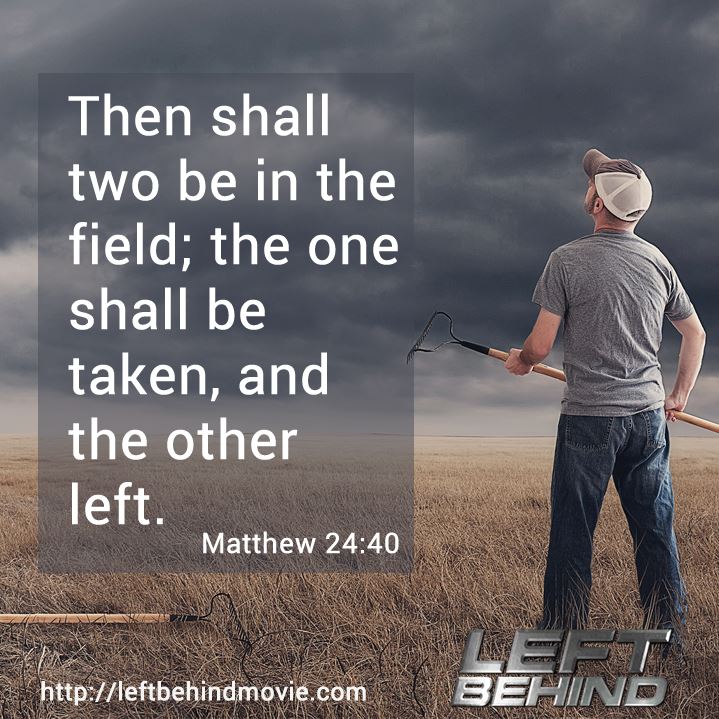
The entire premise of the theology and the Left Behind movie is based on a passage from Matthew that you’ll see in the official Left Behind image included to your left. The passage states:

“Then shall two be in the field; the one shall be taken and the other left”.

And this is where we get the term “left behind”… Jesus said “one shall be taken and the other left.”
Pretty simple, no? It appears from this passage that Jesus is describing an event where some people actually do “get taken” and the others are “left behind.” It must be a rapture then.


Or maybe not.

As I have explained before, the chapter of Matthew 24 is a chapter where Jesus describes the events that will lead up to the destruction of the temple which occurred in AD 70. That’s not so much my scholarly opinion as it is what Jesus plainly states in the first few verses of Matthew 24; it is a context pretty difficult to explain away since Jesus says “this temple will be destroyed” and his disciples ask, “please, tell us when this will happen.” The rest of the discourse is Jesus prophesying the events that will lead up to the temple’s destruction, which we know historically unfolded as Jesus had predicted. (As I have alluded to in What Jesus Talked About When He Talked About Hell and Don’t Worry The Tribulation Is In The Past, if one does not understand the significance of the destruction of the temple to ancient Judaism, one will have a very hard time understanding what Jesus talks about when he talks about “the end.”)

Anyhow, during the end of this discourse in Matthew we hit the “rapture” verse: “one will be taken and one will be left.” Surely, this part must be about the future, and Jesus MUST be describing a rapture. Since that’s what my childhood pastor taught me, it’s probably a good idea to stick with that.
Just one problem: Matthew 24 isn’t the only place where Jesus talks about “some being taken and some being left behind.” Jesus also discusses this in Luke 17 when he says:
 “I tell you, on that night two people will be in one bed; one will be taken and the other left. 35 Two women will be grinding grain together; one will be taken and the other left.”
Building a compelling case for the rapture yet? Not quite. Check this out: Jesus’ disciples in the Luke version of the discourse must have been interested in this left behind stuff, because they ask a critical followup question. However, they actually seem more concerned with those who were “taken” than those who were “left behind” and ask Jesus for a little more information on this whole getting taken away stuff.

“Where, Lord?” is the question of the disciples. Where did all of these people go??

If this were a passage about the “rapture” as depicted in the Left Behind movie, one would expect Jesus to answer something to the point of “they were taken to be with me to wait out the tribulation.” But, that’s not what Jesus says. Instead, Jesus gives them a blunt answer about those who were “taken”: “just look for the vultures, and you’ll find their bodies.” (v37)

That’s right. The ones who were “taken” were killed. Not exactly the blessed rapture.

The Roman occupation was brutal, and when they finally sacked the city and destroyed the temple in AD70, things got impressively bloody. To be “taken” as Jesus prophesied, was to be killed by the invading army. This is precisely why, in this passage and the Matthew version, Jesus gives all sorts of other advice that makes no sense if this is a verse about the rapture. Jesus warns that when this moment comes one should flee quickly– to not even go back into their house to gather their belongings– and laments that it will be an especially difficult event for pregnant and nursing mothers. He even goes on to warn them that if they respond to the army with resistance (the very thing that causes the mess in the lead-up to AD70), they’ll just get killed (“whoever seeks to save his life will lose it”). Jesus, it seems, wants his disciples to get it: when the Roman army comes, flee quickly or else you might not be left behind!

Surely, Jesus is not talking about a rapture. He’s not warning people to avoid missing the rapture because they went home to get their possessions… he’s talking about fleeing an advancing army and not doing anything stupid that will get them killed (v 30-34).

Very practical advice for his original audience and would have come in handy for those who wanted to avoid being “raptured” (slaughtered) by the Roman army.

And so my friends, this is the most ironic thing the Left Behind movie won’t tell you: in the original “left behind” story Jesus tells in the Gospels, the ones who are “left behind” are actually the lucky ones.
So the next time folks tell you that they don’t want to be “left behind,” you might want to tell them to be careful what they wish for.  -Benjamin Corey, link


of course Christians will be left behind

Preface (sigh); Don't hear what I'm not saying. I am not
- See more at: http://davewainscott.blogspot.com/2009/05/of-course-christians-will-be-left.html#sthash.5DxrH5Co.dpuf


--
Adam Maarschalk adds some evidence from sources in 1700s and 1800s:

In our study of Matthew 24:36-51, I also proposed that Jesus said it would be better to be “left behind” than to be “taken,” and noted that 2-3 centuries ago this was taught by John Gill (1746-1763) and Albert Barnes (1834). Benjamin Corey does an excellent job showing the revealing connection between what Jesus says in Luke 17 and what He says in the more frequently quoted Matthew 24:40. His article also comes at a good time, less than two weeks before the remake of the Left Behind movie hits the theaters on October 3rd. Hopefully the theology in this film will soon be left behind by many followers of Christ.  link

Sunday, July 12, 2015

Saturday, September 06, 2014

help a newbie: R.E.M., anybody? U2 vs. REM?


This was previously posted on my facebook here..
be sure to click to see/add comments over there.
--


Some of you will be surprised to hear this, but I came late... really late (after they broke up)... to R.E.M. Sure, I had heard a few songs and liked them, but never owned any REM until this year. That may seem funny, but I just found an article that said you are either an REM or U2 person... well, that explains it--I have been no small U2 fan since 1980!(: But I know geniuses that I think are both (Richard S Rawls??).....So anyone chime in: Favorite REM CD or era? Love? Hate? Argue the U2 or REM theory? ANYWAY.. thanks to the 50 cent sale at Rasputin Music - Fresno... as you can see.. I now have a complete collection of studio albums for about the price of one(: I'm sure I will blog on this in a few weeks, but chime in!


Monday, August 25, 2014

NT Wright and CS Lewis on pointing your dog to something: sign>signified>signpost>sacrament

photo
The whole video here by NT Wright is worth watching.

He so reminds me of C.S. Lewis with his series of apt metaphors.  Here are three


  • Think if I offered you a drivers license, claiming  i had authority to issue it
  • -Think if someone destroyed all bank records and evidence of any debt you owe? 
  • Think what would happen if you pointed at something, hoping for your dog to look at it?
  But let's focus on  the third (4:13ff) here:


 The telling and true-to-life illustration of pointing your dog towards something;
and the temple being a signpost pointing to something (Someone) else is so good.

Try it on your dog, I double dog dare you(:

He may have clarified this in the longer video of which this is an excerpt, but it's likely Wright is  actually drawing (as he often acknowledges) on C.S. Lewis:

The sunlight in a picture is therefore not related to real sunlight simply as written words are to spoken.  It is a sign but something more than a sign, because in it the thing signified is  really in a certain mode present. If I had to name the relation I should call it not symbolical but sacramental..
..I have tried to stress throughout the inevitableness of the error made about every transposition by one who approaches it from the lower medium only..You will have noticed that most dogs cannot understand pointing. You point to a bit of food on the floor; the dog, instead of looking at the floor, sniffs at your finger. A finger is a finger to him, and that is all. 
-"Transposition," from The Weight of Glory...someone has uploaded the whole essay here)

--
Related:

When did dogs figure out pointing?

Dog Breeds: pointing


-"

Tuesday, January 21, 2014

"the price of being biblical is to constantly return to the Bible": NT Wright as irritant

Tim Gombis (great blogger) links this from  Alister McGrath on the topic of N.T.Wright:


Wright’s project is like a gadfly to evangelical theology.  It is an irritant, a stimulus, that demands we reexamine our ways of thinking and interpreting Scripture, particularly Paul’s writings, to see whether we have fallen into settled and lazy ways of thinking that, in the end, fail to do justice to the New Testament.  A favorite slogan of later-Reformation writers was that the Reformed church must be ecclesia semper reformanda—that is, a church that is always reforming itself.  Reformation, rightly understood, is not a once-for-all event whose ideas are to be set in stone but an ongoing process of reexamination and reconsideration, forced upon us by the priority of the biblical text over our provisional interpretations of that text.  Wright obliges us to read the New Testament again and to take the profound risk of allowing our most settled ideas to be challenged in the light of the biblical witness.  The price of being biblical is to constantly return to the Bible, sometimes with anticipation and at other times with trepidation, in that our present ideas may find themselves rendered questionable.  It is a price that I, for one, am glad to pay.
From “Reality, Symbol & History: Theological Reflections on N. T. Wright’s Portrayal of Jesus,” in Jesus & the Restoration of Israel: A Critical Assessment of N. T. Wright’s Jesus and the Victory of God (ed. Carey C. Newman; Downers Grove, IL: IVP, 1999), 178-79.  LINK

Sunday, January 12, 2014

Philemon doing more than Paul asks = ?

Ben Witheringtom on NT Wright's take on Philemon:
When I say that Tom is a global thinker, I also am referring to the fact that he wants to take a holistic approach when it comes to Pauline ethics as well as Pauline theology. The two need to be discussed together, indeed the two belong together and are co-entailed. In one sense ethics involves the living out of one’s theology, living out what God is working in the community to live and to do. Belief and behavior are two sides of one coin, in one sense. Or as Tom puts it in regard to Philemon, the reason it is necessary for Philemon to do what Paul is urging him to do is because of who Christ is— a God who is reconciling the world to himself, and wants reconciliation to be the signature of the relationships within his community.
Tom’s account of Philemon stresses that the main point of the letter is to get Onesimus and Philemon reconciled, back sharing koinonia, as it were. He takes it as possible secondary implications that: 1) Paul wants Philemon to manumit his slave, and 2) to perhaps send him back to Paul to work with him.
I actually think this does not go far enough. When Paul says quite literally in vs. 16 that Philemon should receive Onesimus back “no longer (ouketi) as a slave but above and beyond (hyper) the slave category as a beloved brother in Christ, especially so to me, and how much more to you even in the flesh and also in the Lord” he is indeed making an emancipation proclamation that comports with the implications of Gal. 3.28. In Christ there should be no slave or free (see the work of Scott Bartchy, especially his article published on this blog months ago).
While I agree with Tom that Paul is not like a modern Fredrick Douglas nor is he an ancient capitulator to the existing slave system. He is instituting reform within the context of the Christian community, not in society in general. And in this case the reform involves a fundamental principle– if one is a brother in Christ he should be treated as a person, and no longer as a piece of property, a slave. And Paul is insistent on this matter, speaking of Philemon’s obedience and threatening a coming visit. I take the ‘you will do even more’ to mean even more than manumit, namely sending him off to work with Paul.
What I especially find strange in the sublimating of Paul’s spinning out the social implications of reconciliation is that Tom is one of the big proponents of Paul’s anti-imperial rhetoric. Jesus is Lord and Caesar is not. Christ is the reality of which Caesar is the parody, and so on. But it is precisely that imperial ideology that had led to the enslaving of a huge portion of the population of the Roman Empire. Most slaves became slaves as fortunes, or better said misfortunes, of war.
Paul surely knows this, and since Paul was a global thinker he surely would have realized that opposing imperial ideology involves opposing the enslaving of much of the world. If Caesar is not the Christian’s lord, then Christians do not have to obey the dictates of Caesar when it comes to the slave trade. Paul is working for change within the context of the Christian community, not in society at large, but he is working at it, as Philemon shows, and as C.F. D. Moule was to say, Philemon provided the ammunition in early Christianity for a strong opposition to the contradiction in terms implied in having a Christian slave. Moule in fact suggests Paul provides here the depth charge which would eventually blow up the institution of slavery.
It is important however to end this post on a positive note, as there is so much to learn from Tom’s excellent reflections in his first major chapter (74 pages long). It is useful to remind ourselves of Tom’s helpful reiteration of his approach to texts and realia both ancient and modern– namely critical realism. Here is what he says it is, “a self-critical epistemology which in rejecting naive realism which simply imagines we are looking at the material with a God’s-eye view, rejects also the narcissistic reductionism of imagining that all apparent perception is in fact projection, that everything is really going on inside our own heads. Critical realism engages determinedly in a many-sided conversation, both with the data itself and with others (including scholars) who are also engaging with it. The conversation aims not at unatttainable objectivity, but at truth nonetheless, the truth in which the words we use and the stories we tell increasingly approximate to the reality of another world, in the historian’s case, the world of the past.” (p. 51)  link

Thursday, December 19, 2013

"Pope" N.T. Wright asked on Facebook about capitalist consumerism's spiritual side effects


NT Wright doesn't post statuses, selfies,  pictures of cute cats, memes and pics of his lunch on Facebook..

                  but he does answer a couple of questions a month on his page (:

Like this one below; interesting in light of  (and likely inspired by) the pope's recent comments


Question 1 from Simon Meadows:
“What might Paul make of our western culture of capitalist consumerism and its spiritual side effects?”


The answer from N. T. Wright:
“Paul would recognise current western consumerism as one aspect of a cultural phenomenon he knew well, namely that of a global empire. Wealth flows to the imperial centre (think of Revelation 18). The difference between his world and ours is that the number of people at the top of the pile has increased – the elite now numbers millions. But the proportion hasn’t changed that much: for every million elite consumerists (with more possessions than they can store in their own homes!) there are a billion non-elite living in poverty or near-poverty, with very limited access to clean water, medical care, education and so on. What would shock Paul particularly is that a great many of the first category claim to be followers of Jesus, and yet some of them at least seem not to mind the fact that their wealth sits on the back of the poverty of others (held in place by the unpayable debts incurred by silly western bankers lending vast sums to corrupt dictators in a previous generation). When Peter and James told Paul to ‘remember the poor’ (Galatians 2) this wasn’t just a reference to poor Christians in Jerusalem. This was a reference to an entire way of life in which the needs of the poor became the paramount concern of Jesus’ followers. The whole western church needs to learn and re-learn this lesson, which is radically counter-cultural in our post-enlightenment world where we assume that because ‘we’ are the ‘enlightened’ or ‘developed’ ones we somehow have an automatic right to the benefits of consumerism. Of course, we are all compromised (just in case anyone supposes I am blind to my own complicity with ‘the system’: as I was writing this answer there was a ring at the doorbell and a delivery arrived from a well-known department store . . . ).  link

Monday, December 09, 2013

Antiochus Redivivus

Just as we shouldn't read the "temple tantrum" texts without getting the Antiochus Epiphanes/Judah the Hammerer connection (as N.T. Wright reminds), it's good to connect the Christmas/slaughter of the innocents story to  Antiochus Epiphanes as well (as Craig Keener reminds below:

....Regardless of how much Matthew's original audience knew about Herod's brutality, however, they could envision him like the anti-Jewish tyrant Antiochus IV Epiphanes, who also slaughtered Jewish babies. Most of all, they would associate Herod's behavior with that of Pharaoh of old, who killed baby Israelite boys in Moses's day. Ironically, it is Egypt that here provides Jesus's family refuge, and in the angel's later words to Joseph ("Return to Israel, for those who wanted to kill the child are dead") Matthew echoes God's words to Moses: "Return to Egypt, for those who wanted you dead are now dead themselves." Political corruption makes Jesus's own home the most dangerous place for him...link

Practical implication:

If made explicit, such contrasts between the political king and his new rival could connote treason, but the rest of Luke-Acts shows that Jesus and his followers are not out to violently overthrow the empire. Rather, they work for change as they pray for the coming of God's kingdom.

What we learn from the first "Christmas stories," then, is more than a challenge against seasonal greed, gluttony, and grudging giving. It challenges us to consider to which king our loyalty lies. Do we pledge first allegiance to those who achieve power by violence, intrigue, and economic or political exploitation? Does it matter where our wealth and merchandise come from? Or do we pledge first allegiance to different values, identifying with those in need and working for peace and justice in the world?

If it is the latter, these are values not only meant to be celebrated during Christmas season. In both the Gospels of Matthew and Luke the earliest scenes of Jesus pave the way for the rest of his ministry of healing and restoration and its culminating conflict in his execution by those who considered him a threat. In context, then, these first stories about Jesus's birth challenge us to follow his sacrificial way of life, no matter what it costs us.   link