Welcome! You have accidentally reached the blog of a heteroclite follower of Jesus: dave wainscott. I'm
"pushing toward the unobvious" as I post thinkings/linkings
re: Scripture, church and culture. Hot topics include: temple tantrums, time travel, sexuality/spirituality, U2kklesia, role of the pastor, God-haunted music/art..and subversive videos like these.
Ironically (or not), the album became the genesis (pun intended) of the revolutionary "gated drum" sound which eventually went hugely viral with the iconic and accidental (in both senses of the term) "In the Air Tonight" drum fill on Phil Collins' first solo album.
Having worked previously with Eno (the "Enossification" effects on Genesis' "Lamb Lies Down on Broadway" album), Gabriel may well have been inspired by Eno's "oblique strategies" of forbidding certain instruments or chords in songs, to see what unsolicited creativity would happen in the dare of the discipline (see "Oblique Strategies")
What have you learned about/from forcing yourself to work within certain structures and limits? How has limiting the palette opened up liminal and larger space..and thin places?
As a heteroclite theologian who is ever Pushing Toward The Unobvious..
I also wonder/wander if in works of art pondering the divine, what unique anointing there is in limiting the palette and downsizing the arsenal/toolbox of words and wineskins.
I wonder how Ed's being a Zen practioner shapes the form and content of his art?
What might I learn about God, life and myself if I write/voice my theologizing (laments, midrash and "reversed thunder") prayers in Haiku?
Here is a Haiku (a HAIKU TRILOGY, no less, I like 3s) from late Methodist pastor Cynthia Langston Kirk , and a poem from Ed which pique my holy curiosity..
Thanks to Mark DeRaud for the tip on the post below by JD Walt. Of course, I have taught that according to Joel 2/Acts 2, the last days began at Pentecost.
Peter preaches, and says "What you see is the following; "In the last days....I will pour out my Spirit.."
14 Then Peter stepped forward with the eleven other apostles and shouted to the crowd, “Listen carefully, all of you, fellow Jews and residents of Jerusalem! Make no mistake about this.15 These people are not drunk, as some of you are assuming. Nine o’clock in the morning is much too early for that.16 No, what you see was predicted long ago by the prophet Joel:
17 ‘In the last days,’ God says, ‘I will pour out my Spirit upon all people. Your sons and daughters will prophesy. Your young men will see visions, and your old men will dream dreams. 18 In those days I will pour out my Spirit even on my servants—men and women alike— and they will prophesy. 19 And I will cause wonders in the heavens above and signs on the earth below— blood and fire and clouds of smoke. 20 The sun will become dark, and the moon will turn blood red before that great and glorious day of the Lord arrives. 21 But everyone who calls on the name of the Lord will be saved.’[c]
-- But Mark's comment (based on the Walt post) pushes a huge envelope: "The last days ended with Pentecost." -Mark DeRaud. What do you think? This raises the question about whether verses 19-20 have happened yet? Of course, the party line is that the sun darkening and the red moon are signs of the "end of the end, "and they obviously haven't happened yet. Yet many including NT Wright make the case that this was a symbolic way of speaking of the events of AD 70: destruction of the temple. (see what Wright does with the Isiaah 13:10 sun and moon signs here. See also a couple posts by Kirk
I was talking with a well-meaning leader just the other the other day who began discounting my outlook. He said, "J.D., your view is preposterous. Don't you notice how terrible things really are? Don't you know what the Bible says? 'There will be terrible times in the last days'" (2 Timothy 3:1).
Another man suggested that I was a "scoffer." He said, "Don't you know what Jude, the half-brother of Jesus declared, 'In the last times scoffers will arise who will follow their own ungodly desires' (Jude 1:18). If you don't see things getting worse, you're nothing more than a scoffer - rejecting the Word of God."
Many insist that the Bible foretells disaster and trouble - particularly as we descend into the "last days." They're convinced that, in the grand biblical narrative, cataclysm and destruction are imminent. It seems that there can be no goodness or hope in "perilous times." This kind of worldview is understandable. A superficial reading of the New Testament would suggest the reality that they're asserting. However, things are not always as they appear.
The term "last days" is arguably one of the more misunderstood phrases in the Bible. It is not talking about the end of the world, but the end of the “old covenant” era.
Rather than referring to the destruction of the earth, it is a depiction of the end of the temple, animal sacrifices, and Levitical priesthood. It spoke of the unrest and volatility that would be found at the cessation of a religious order that was, at best, temporal in nature (Hebrews 6:20-8:13).
It might surprise many to hear this, but the writer of Hebrews affirms that the last days were in his lifetime. He declares that the revelation was being received, "in these last days" (Hebrews 1:2). Elaborating on what this meant, he goes on to declare that "Jesus has now obtained a more superior ministry, since the covenant he mediates is founded on better promises" (Hebrews 8:6). The “Last-Days” or “End of the age” is really about the tumultuous transition to the New Covenant order. It is the end of what was and the beginning of something new! It was never meant to be used as an excuse to sidetrack the good news of the gospel. link
Here are some of my thoughts, pics and videos (some by others) of U2's " Innocence and Experience" tour 5/19/15 San Jose (second night) stop.
It's only four nights into the tour, and as Gavin Friday quipped, "It usually takes six nights for the Baby to become Achtung."
I think this time the Mojo is already in the house, as is the Baby.
Premature, but healthy.
Also...Second nights (or third, fourth...of fifth) by U2 in the same city are often characterized as "walking all over the first night." (see "U2 is good, not great in San Jose"night 1) . This sometimes reminds me of what Mark DeRaud used to call the fourth (of our four Sunday church services (they went from very traditional to traditional to contemporary to...uh, very contemporary): "the exotic service." For U2, it's a bit looser (as far as nerves), tighter (as far as music) , and sometimes that results in more Spiritaneous setlist moments. Tonight was, as Tim Neufeld tweeted me below, exquisite. Tim N also catches a liturgical phenomenon that can happen with the night one vs night two: "Where the first night in Vancouver reminded me of the fallenness of our humanity, the second restored a sense of hope. " Bono once told Rolling Stone, "They call it the rhema. It’s a hard word to translate from Greek, but it sort of means it changes in the moment you’re in. It seems to do that for me." Edge:" It's funny how you take an old song, but it in a different part of the set, and it suddenly has a new meaning."
Sitting next to me was another Tim, my son --a Periscope broadcasting star who had hundreds of viewers from all over the world! (Check to see if his video is still viewable).
@davewainscottHH So that's who @Tim4Jesus is! A real hero to many! Glad you could go w your son. Lifelong memories and an exquisite show!
It's impossible..and should be illegal.. to unpack a concert by U2. (I still haven't come home from my first!) I won't even try. Just a few highlights this time.. I won't even go in chronological/liturgical order.. But I know which song to start with: "Bad".. ...but where to start in commenting on this Bad 6.0 version.? (Note that in The Matrix, Neo was the sixth..and final.. iteration in a series of candidates to be "The One") As Tim Neufeld noted:
On past tours, U2 challenged crowd on political fronts. The #U2ieTour is much more about inner human condition. #surrender#youarefree#AB
Bad, which the other night (Second night, Vancouver) had the amazing addiction-recovery altar call (see this), tonight's version (unplanned, as you can tell by the first moments..) had this tearful "Into The Mystic" intro followed by the "This is a song of surrender..Whatever it is you want to let go of tonight, let it go ..be free!..you are being freed. ...Our music, God gave us it.." invitation/prelude,, (Not sure what he says at 27-30 sec mark. Anybody? "it's just dissonance"?):
A vintage interview:
WENNER:
Do you occasionally lose control when you’re singing? Not get out of control, but you just get so transported into the song.
BONO:
That’s when it’s good. When it’s good you don’t know it’s happening. It really is an extraordinary thing because it seems to require no effort. And of course the other side of it is you can bump into some aspects of your character that you’d rather not have bumped into.
WENNER:
What are you trying to do with the audience?
BONO:
To lose my own sense of self, self-consciousness – and theirs. It’s an amazing thing. We’re not really a rock & roll band. We’re pretending to be a rock & roll band, and sometimes we get away with it.
Sometimes a song like “Desire” or “Vertigo” will arrive, and you go, Whoa! That’s rock & roll! But what we actually do is something completely different. Our set list is designed in a kind of three-act structure, to get people out of themselves and to get ourselves out of ourselves. And to get to that place where everything feels possible and you want to call your mother, leave your wife, start a revolution or crack open the piggy bank and go on holiday for a year. link
---- Hmm..Second night; fourth service; third act.. or as Edge just said: "There's really four different phases within the show of quite different feelings. Then we're tying it together. Making the emotional arc of it work is the real challenge."
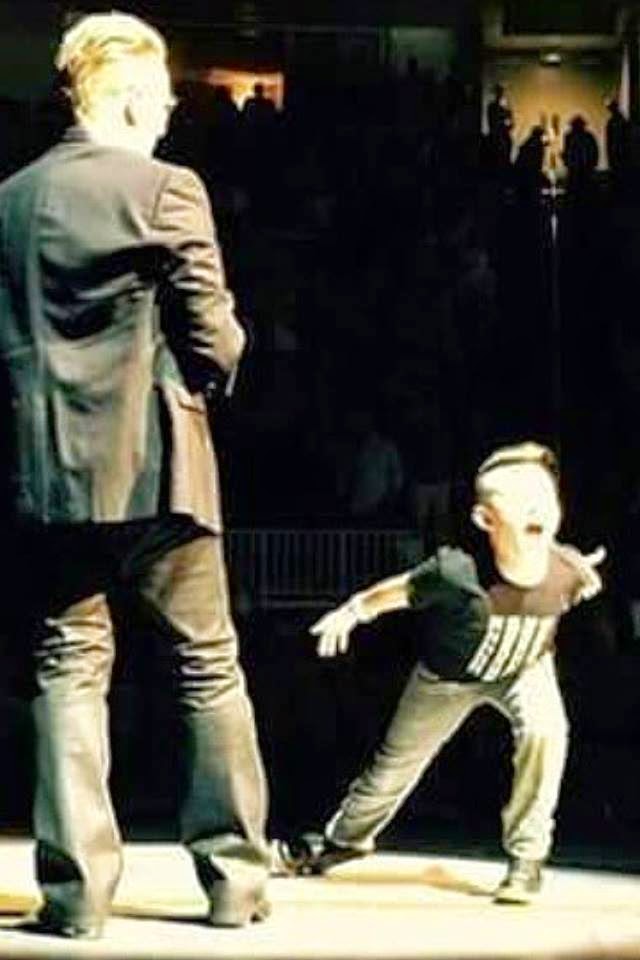
At one point, it sounds like they were plotting a lot more moments (technological and lyrical) throughout the songs and show where the older Bono(or band) would talk to their younger selves, and vice versa) . Even though Bono obviously "talked" to his younger self at one point "Song for Someone" (which took the song to a whole new level (of many) meanings, some of the moments would be harder to catch..like these new lyrics in the "Bullet" rant:
So this boy comes up to me, His face red like a rose on a thorn bush, A young man with a young man's blush, Young boy looked a lot like me.
And he's pulling the dollar bills outta my hand, Patting me down, patting me down, Says you have more than you need! You got 100, you got 200, 300
And I can see those private planes, I can see those private planes, And you're in one of those private planes aren't you? And he's right.
And I'm off a flight in Davos, Switzerland, I'm in the lobby of the Belvedere Hotel, Where a jazz-man breathes into his saxophone, While everybody stares at their cell phone, And in my ear the young boy groans,
Outside it's America! Outside it's America!
[Solo]
As I step outside, snow is falling like a curtain of silence I'm on the other side of the barricade now, I'm on the other side of the barricade to myself, aged 19, n-n-n-n-nineteen
And I try to tell the young man, that ideas deserve a plan, And to build a better world, It's gonna take every woman and man
It's gonna take you, me, The reds and the greens, The nows and forevers and the yet-to-bes The "where ya going?" The "where ya been?" The living and the dead, and the unseen The somebodies, The nobodies, The who's who, The Gentile and the Jew, The gays and the straights, The sevens and the eights, The nines and the tens, The Dollars and the Yens,
And I feel like a fraud, but I know that I'm not,
I try to do my very best, with everything I've got, which is not a lot, to not get caught, with my pants down, my hands up, my hands up
Any second now, Things are going to get rough, So I run, I run, I run, Into the arms, of America link Sherry said:
Bono’s channeling his inner hypocrite, changing the lyrics from “fighter planes” to “private planes,” shifting the focus from military interest to the Occupy Wall Street movement. “You’ve got more than you need” is part of Bono’s rap. It’s a conversation he’s having with his 19-year-old self who would see him now and condemn him, and his 55-year-old self is explaining the purpose behind it all. He’s trying to reconcile that he’s become the thing he protested all those decades ago. The reinvention of this song is outstanding. - See more at: http://www.atu2.com/news/column-off-the-record--vol-15-671.html#sthash.R51Fpw2Z.dpuf
Bono:
The core idea behind the Innocence + Experience tour is this movement from "them and us" to "there is no them, only us."
When we were younger our enemies were clearly drawn, very visible to us. They were very real, they weren't imagined. And we organized against them, whether that's with Amnesty International or anti-apartheid groups. As you get older, you start to discover that the greatest enemy you will encounter in your life is often yourself. You are the biggest obstacle in your own way. Suddenly then the landscape changes. I don't know who wrote the line, "I have met my enemy and it's partly right," but it's a great line. It's a book title. When there's no clearly defined "us" and "them," the world changes shape. It's harder to negotiate. It's really your own hypocrisy in the crosshairs. We started that journey with Achtung Baby and Zoo TV. It continues today, but what's happened recently is that I've personally been revisiting the black-and-white monochrome days, because I miss that person.
I'll give you a lyric from [the upcoming U2 album] Songs of Experience. "I was living a lie. I was calling it a compromise. I was making bad deals in front of everyone's eyes. Deals now everyone denies. I was giving evidence in the court of the hearts desire, falsifying documents, virtue thrown in the fire. Sometimes I wish that I was stupid and you were not so smart. Overcome the head will always overcome the heart." The chorus goes, "Lead me in the way I should go. I'm running out of chances to blow. That's what you told me and you should know. Lead me in the way I should be. Unravel the mystery of the heart and its defense. The morning after innocence." The song is called "The Morning After Innocence."
Then it goes, "Is that your fountain pen? Navy with a nib of gold. Could you write your name again and do anything you were told in 10 Cedarwood Road. I'm your older self, the song of experience. I've come to ask for help from your song of innocence. Lead me in the way I should go. I'm running out of chances to blow. That's what you told me and you should know."
So, the older self is coming and asking the younger one for hope. It's interesting. It's a reverse. That happens in this show. What happens in this show is the younger self harangues, harasses, the older self. That's what we were just practicing out there trying to figure out in "Bullet the Blue Sky." The guy who used to be on the barricades in black and white comes up to the guy who is on the other side of the barricades and says, "What are you doing here?" He says, "It takes everybody. It takes the blues, the greens, the me's, the you." He goes into this rant. That's the dialectic at the heart of the tour from a lyrical perspective.
Tell me about it. To me, the film on the screen during "Streets" showed creation/our current city-creation..including the Joshua Tree... with a collider/transmitter/transporter to New Creation/heaven/heavens..
..or something like that. (:
photo Tim N
Someone captured this, see 3:37ff...and the rock(Rock)/mountain (Mountain) at 5:32ff? Love it:
U2 Cedarwood Road
Bono inside the screen, walking the road he grew up on. "Come with me, see the road I should've grown up on.."
Posted by Dave Wainscott on Wednesday, May 20, 2015
I was stunned to see this title at the used book store.
I shouldn't have been.
It's a classic Reformation principle .. for some.. that words are more important than images;
even that any images/imaginations of Jesus..therefore art..are forbidden as they are idolatry.
Note the picture (image!) on the cover consists of words about Jesus.
The well-meaning, but misguided premise, according to the author's blog:
Pictures "de-present" Christ—much more than they "re-present" him. The purpose of this book is to call Christians back to the Bible for their revelation of who Christ is.
The pictures everybody uses to represent Christ are not pictures of
Christ at all. They are forbidden by Scripture. They are rooted in a
non-biblical monistic idea of God—akin to pantheism. They become idolatrous, not just when they are "worshiped," but at the moment they are given the name of Christ. link
The whole book can be read on the right-hand bar of the author's blog.
An ironic quote: "This book is necessary to bring Christians to their senses."— Richard Bennett
Hmm, primacy of senses and primacy of word..
The author comments:
"'The Passion of the Christ' movie by Mel Gibson...That is perhaps the deadliest influence of the movie is its
subliminal denial of the Deity of Christ. Those who made the
movie can insist that this man on the screen images Christ.
Promoters of the movie may claim that the movie proclaims the
Deity of Christ. But the movie makes us call Jim Caviezel
“Christ”. This is idolatry. link
As Mark DeRaud wrapped up his chapel message for Fresno Pacific Biblical Seminary
today, he said...well, play the video here below. It will help to have the end in mind for anything else I quote him as saying throughout his talk:
I think it was recorded, so I will post the audio soon as possible. Here are some highlights:
1)A pastors/leader should be
coach
curator
counselor
teacher
I don't have to tell you which two Mark suggested we haven't emphasized/trained for (:
2)You can see what his scriptural backdrop was..one of his paintings. His Scriptural backdrop was Isaiah 29: 13-14
The Lord said:
Because these people draw near with their mouths and honor me with their lips, while their hearts are far from me, and their worship of me is a human commandment learned by rote; so I will again do wondrous things with this people, shocking and amazing. The wisdom of their wise shall perish, and the discernment of the discerning shall be hidden.
By the time he was done we had a sense that the painting made the same message.
Ask him about it.
As a starter, note the two men reading with no ears or eyes.
One of the curses of the Reformation is that Protestants tend to rely on words only, on not images.
"The mind is plastic," he maintained.
Even in us older modernity-based focus, the visual/image base of the brain can be restored.
Limbic system science is clear that new (old) pathways can be formed..through art. See these links.
God will do wondrous things through us, as we regain our new mind.
And check out these video interviews I did with Mark about the fallout of the Reformation.
3)He spent a good amount of time sharing his experience of being invited to paint murals
at Holy Spirit Catholic church, and the service he was invited to where they were unveiled. Complete slideshow of the murals here or here.
I can't believe Mark's classic posts on that experience have been taken down.
Here are the original links, in case someone can find them on the Internet Archive/Wayback Machine page for the original site
I can't.. argggg...they must be there somewhere!):
Today, the take home was, as he posted on facebook:
I was confronted with a body of believers who considered my
artistic gift a vocation rather than a curious, useless affliction in
the Kingdom of God.
It was the only place or time I was asked,
"Did you think the service was beautiful?" A thought my Protestant mind
had never considered, let alone would have an opinion.
I was given a position paper on the value of art, written by the Pope. I
wept. I wept because I had fought against the call to be an artist,
because to be an artist in my Protestant culture was to be,
essentially, claimed useless, a non-thing.
The only 'important calling' I understood was to be a book reader and speaker, a preacher. link
He said of the Catholic church, "their entire place had a language."
I pray some and try hard not to be an idiot..
..or the seducer (see this, this and this) that the pastor/teacher role and expectation can inevitable invoke/evoke.
So once again I found myself buying a book at the thrift store (the price is right, and it's a place where O have learned big lessons about how and how not to pastor..that sordid story here), buying a book I wouldn't buy at full price; one with a title or cover I'm a bit embarrassed by..
This time it was "The Art of Seduction"...which I bought to help me in my reduction of seduction.
Very Screwtape-ian..and MacPhisto-esque of me, eh?
(There are no pictures in the book, and it is SFW..unless you are a pastor!)
Oh, one of the others in the stack I was concerned the clerk might misundertand also.
It was "No One Left to Lie to: The Triangulations of William Jefferson Clinton," making the case for Clinton's impeachment. What I didn't want the clerk to think it that I was some conservative who automatically hates liberals. What I love about the book it makes an articulate and compelling case; argues not so much from sex but violence (violence to cover up sex)..and it is written by a liberal (Oh, there's one more good book on Clinton by a liberal..a Jew who had voted for him, but wouldn't again).
The author makes the case that Clinton was a master at "staging" things (p. 101); even using his daughter as a "prop" (78)...and these were seductions and "detractions" of the public to cover up his private seductions. I try to be so careful and prayerful that I don't stage things, or use things/people as props. But that's what we pastors do by default (Pay no attention to that man behind the curtain..) See these links on "stage":
And on "props," Vincent J., Vera has already said it...sung it (embedded below).I don't know if VV ever saw the double meaning of "taking the props" home, but if you think of "props" in the vernacular sense of "Kudos" "appreciation" and "proper respect" those too are items that pastors take home at their own risk... ..and self-seduction.