Showing posts sorted by relevance for query retrofuture. Sort by date Show all posts

Monday, February 13, 2006

THE KINGDOM’S RETROACTIVE RETROFUTURE: SEND ME MORE ARROWS


THE KINGDOM’S RETROACTIVE RETROFUTURE: SEND ME MORE ARROWS

“Though we may never prove it scientifically and by formula ; it seems inevitable that we will eventually taste it experientially and by faith: the arrow of time is not uniderctional, and may most fundamentally operate from, and originate in, the future ”

This created but representative quote from the field of physics, as shocking as it might sound, is so common a working assumption of post-Einstein physics that anyone conversant with the discipline will already be nodding off… blah blah, yada yada, tell me something I haven’t heard..And if you’re not a scholar for whom this is a 101 basic bonehead assumption, then the implications of the quote might ring esoteric and resound like clanging gobbledygook if you don’t get it, and resolutely ridiculous and absolutely impossible if you do. But its proposal must be wrestled with; it is neither too wild-eyed to entertain, nor too throwaway to flirt with. Don’t dare diss it; discuss it. It may well be the very keychain of the Kingdom, and that’s nothing to throw away. I must commend physicists for inviting this proposal into the professional, public and Christian areas; for whether such researchers are searchers or not; are Kingdomed (Tom Fuller’s marvelous word) or not: they are, in the language of the Kingdom’s King, “not far from the Kingdom of God” in such a suggestion.

Is it about time working backwards? Well, yes, but in a frontwards kind of way. More on that later, but I’m guessing some are scoffing , “That’s impossible!”. Of course it’s impossible. That’s precisely and prophetically why we must consider it possible:

“’You speak of impossibilties, ’ interrupted the King. ‘You must have seen a vision.’”
(p.59, Flatland)

“For only one thing is impossible with God: nothing.”
(Luke 1:37)

No wonder Einstein required his disciples to read the first book quoted above. No wonder Einstein’s creator requires His disciples to be read and heed the second Book noted above. Both teachers intuitively knew that there is something radically freeing in at least opening oneself to…at least for the science’s sake, if not for Christ’s sake…the possibility of impossible possibilities. Otherwise, no human could muster a mustard seed of hope. Without hope, we die. Inveterately we live in hoplessness; inevitably we die of and by it. No theologian has pondered this in a more profound and practical way than Jurgen Moltmann. Watch the astute linking he establishes between hope, the future and possibilty:

Since Christian faith lives in hope, there is only one realproblem in Christian theology—the problem of thefuture—and hope is the foundation of theologicalthinking as such. Moltmann takes a strong stand againstthe mysticism of being because he thinks it presupposesan immediacy to God which the faith that believesin God on the ground of Christ cannot validly adopt.Future-oriented, he rejects much of the Hellenic worldview. For him, all knowledge in faith is anticipatoryand fragmentary; its mobilizing force is hope, throughthe medium of which all theological judgments func-tion as showing reality its future possibilities. More-over, “creative action springing from faith is impossiblewithout new thinking and planning that springs fromhope” (Moltmann, “Theology of Hope” 1967, p. 35).

Moltmann's theology of hope understands history as a reality
instituted bypromise. That is, there is a relation between promissio and missio such that the Christian consciousness ofhistory is a consciousness of mission. In this view, then,the reality of man is historic and progressive, andrevelation too is progressive in that it creates progress.
Dictionary of the History of Ideas, p, 215
http://etext.lib.virginia.edu/cgi-local/DHI/dhi.cgi?id=dv2-25

Revelation is progressive, and it does indeed lead to progress. But it may well be that, like time itself could be, and like the Kingdom itself clearly is…such life-saving and crucial hope is God- gift from the future to the present; progress progresses from the future, and unfolds and completes and lands in the present time.


So, anyone wanting or needing hope (that’s all who are breathe, as Hugo was hugely right: “Hope is the word written on the brow of every man”), and at least claiming a spirit of honest enquiry must… by default or design... “do” theoretical theology…in a way that hopes for..at least hopes to hope for..the impossible. Only then, as the power and promise of the “future and hope” (Jeremiah 29:11) unfold among us in the her-and-now, can the “creative action springing from faith” spring at all. It’s our only hope! “It impossible for hope to disappoint,” according to the bold blanket promise of Paul in Romans 5:5, for at heart it is hope that actually “saves us” (Romans 8:24). Find it impossible and hopeless to risk believing in God? Fine, “try on” a temporary believing anyway, and see what happens. What do you have to lose?, Pascal’s famous wager still asks. Find it impossible to believe that the arrow of time might, against all odds and impossibilities, also “run backwards”? Fine, even if you have no reason; “test drive” the temporary and tentative belief and hope for season, and watch what just might emerge. What do you have to gain? Lots, even to the degree of witnessing your life changed and rearranged in wild and wonderful ways you never had even conceived or hoped for when you innocently started this essay. That’s the scope and sweep of this chapter, and I indeed wager the farm on it.

So you don’t have to check your brain at the door to continue in good conscience, but I do recommend adopting the timeless wisdom of the mystics: “descend with the mind into the heart.” Read that again, make and manuever the descent; even if it calls for a radical dismantling. Then your descent down the page will flow more naturally.

What’s “up” with all this descent? And what’s going on with all this talk about the direction of time’s arrow? Back to the Future? Back From the Future? Time travel? Maybe, but basically it’s just back to Jesus’ keynote sermon: “The Kingdom of God (which operates and originates in the future) has now arrived (in the present). Therefore, turn yourselves and your understanding around”

Anyone familiar with the life message of Fuller Seminary’s George Eldon Ladd will be able to summarize: Jesus’s gospel is all about the Kingdom of God, a reality which belongs first and foremost to the future (the “age To Come”); invading and lopping over into the present (“this age”). Why was Jesus murdered? For daring to teach that, in Him, the Kingdom had already begun to come on earth as it is in heaven. Inextricable from a Jewish concept of the Kingdom of God is that such a reality..because it is the property of the future messianic age, and age and time completely wall it off from this current, evil, earthly age.
One could only preview the Kingdom prophetically; not view (postview?) it proleptically. Jesus and Paul ..and God..being good Jews. clearly pick up on this teaching , and do not subvert, highjack or framyank it, but are consisitent and insistent with its tenor, but recogogize that in Jesus, the Impossible has come; the eagle has landed. By the Spirit they steer this existing theology towards its shocking and inevitable “holy coda” and (il)logical extreme: Even though these two ages are dichotomized and walled off, in the invasion of the impossible that Jesus has inaugurated, the future has come; and by definition it can only wander in from one direction: “backwards” from the end of the timeline, and ..against all known laws of physics of the day (but not against what contemporary physics has since discovered, which is precisely the point of this essay and its exuberance) into the currency of our “current” life. Eternity, a gift from and of the future, has begun visiting, affecting and effecting time. Kingdom is “here and now” and not merely “then and there.” Reversibility is irreversible. Every good and perfect blessing one receives from God is a gift, not from the past (though we are historically rooted, ..especially in the crucifixion/resurrection event), from the future.

“The presence of the Kingdom of God was seen as God’s dynamic reign invading the present age without (completely) transforming it into the age to come, ” (p.149, The Presence of the Future.”) Ladd asserts; taking careful and prayerful note of the necessary “inaugurated but not fully conumamted,” creative teension of the “now and not yet” mix which has caused so much fuss and ink to be spilled by theologinas. Unfortuntaley, we are not comfortbale living in paradox and creative tension. Yet the tension is designed to snag our attention. And it got the attention and guard of the religious leaders/theologians of Jesus day alright; the only filter they had for him was heretic. He broke the kingdom/two age teaching, or so they thought. In reality, of course, he came to “fulfill, not destroy.” Ladd gets this: it is this in-breaking without a change of age that is the very springoard of Jesus’ message and ministry.


Since have acknowledged the cruciality (literally, “cruc” as in “cross”) and crux (ditto for word origin) of our faith’s history , it is wisdom to park here for awhile and ponder the past. For one, to ensure and insure our grounding at the cross’s historical and holy ground.. Secondly, to trace the grounding wires of this holy grounding from the cross(an event in the past) to the Kingdom (a future “event” which embraces and encompasses the present and past)..or vice versa. Appropriate also at this juncture to quote a fiction writer, as isn’t that the best way to get a handle on non-fiction? No don’t worry, we won’t jump to HG Wells’s Time Machine or Zemeckis and Gale’s “back to the Fture. Let’s start a little more squarely in Christian orthodoxy; with the master of Christian fiction and non-fiction.” In “The Lion, the Witch and the Wardrobe,” a volume in C.S. Lewis’s “Chronicles of Narnia, it is said of Aslan, the Christ-figure, and his substitutionary death on a “table”:


'When a willing victim who had committed no treachery was killed in a traitor's stead, the table would crack and Death itself would start working backwards.'"

Death working backwards; time works backwards, reversing the curse…but it’s all historically grounded in a specific “time and place” table ..even if in another dimension, or parallel universe/parallel time. Too wild? Hey, note, in the definitive “non-fiction” book, “when” the crucixion happened: “before the creation of the world,” or “before time began.” Historic? Prehistoric? Post-historical? Choose the prefix to affix: trans-, sur-, pan-, etc. Jesus died before being born? The cross before creation? Time out! (Exactly! Literally!)

Tuesday, July 15, 2008

Wednesday, September 08, 2010

How quickly do you blush in cybertime?

Her run-on sentences are delightful.
Time-bending, even.

I love Jay Griifths books and you should do.
Read them yesterday.

Since all good books are

              timeless or timely or time-travel..

I was thrilled to hear that she wrote a book entitled, "A Sideways Look at Time."

Indeed that is the only angle we have on it.

A few blurbs:


“A wonderful, delightfully humourous polemic against everything that's wrong with the way we deal with time today” - The Independent , Books of the Year

“An irresistibly provocative and political analysis of time... Her wittily enthusiastic thesis is that time has too long been used as a tool to power: as a manifesto, it could cause a revolution.” - Iain Finlayson, The Times , Books of the Year
A major book by a woman who is, no question, a major writer. … she writes like four kinds of gorgeous, so deep in love with the world that when the right word isn't there she simply births it… a majestic anthropology” – Bill McKibben , The Ecologist
“Jay Griffiths has the gift of insatiable curiosity. She is intensely aware of the world around her, its wonders, its horrors and its absurdities. She questions and protests and celebrates – all in a language which is constantly alive, often sparkling and deep, like a good river. She is a revealer and a healer - to travel through time in the company of such a magical writer is a delight.” Adrian Mitchell , Shadow Poet Laureate.   LINK


To preface today's excerpt, let me say it's an excellent passage on the downside of "cybertime."
But I also want to know: Can cybertime also bring us closer to Kingdom worldview and timeview?
(see, for example, "

I would love to go back in time and ask Gerge Ladd this question...
Internet time might be a Time Machine to Kairos.)


Oh,  by the way, I am   (and you should too) soundtracking  (in cybertime and cyberspace) this book excerpt to U2's "Moment of Surrender" (recorded in Amsterdam) in another window..
That I am able to do this  of course exemplifes part of the point about internet life/time...but when Bono moves into his Spiritaneous prayer and recitation of Psalm 40, as he rocks back and forth wailing wall style (What  is the technical term for this prayer movement, Rabbi Adam? ), it just seems so time-transcending to me ( I guess all prayer  inevitably is, if it is Kingdomed prayer ); So Sabbath-ing, as in Heshel's "Sabbath as a Sanctuary in Time,"


Maybe all Jewish prayer is "timely" since "the Jews invented history."


(By the way, this is not the first Jewish prayer method Bono has moved in, see this on elevation-prayer, this on nigun, etc..  And see this to find what the prayer portion of this song evenually became).


---
Griffiths:


But the creation of cyberspace means "cybertime,"  virtual time which itself is like a fifth element, of Teflon time, within that element, people virtually shop and set up business and fall in love...
Michael Castells, in his exhaustive three-volume work, The  Information Age, describes the network society and information technology creating "a timless time," negating past and future in a  hypertext communicated anytime anywhere.  Castells decribes the time of industrialism, the schedulization of human behavior, as "clock time"  and contrasts  both timeless time and clock time with "glacial time"--a key feature of environmentalist thinking; both looking far back into the past and forward into the future.

But in this timeless-time, or replica-time, it is only replicas of ourselves who can live; hoping to cheat nature, it can actually cheat life..
You cannot have humanity in this timeless zone because relationships are suffused with time. How quickly you blush; do you pause before you speak; do you laugh before, after or during your own jokes? How soon do you smile before you weep, which is the last gap before you gap with delight; and is your hesitancy thatt of sleepiness or shyness?  Can you bite your virtual tongue? Is there such a thing as virtual spontaneity?..
...Every act in virtual time is finite, final and finished.  No human act is.  This is its pity--the act without consequence, cruelty without remorse,  sex without hands and jokes without laughter.
-Jay Griffiths, A Sideways Look at Time, p. 270-271 (click title to testdrive the book)
 Another excerpt here.

Saturday, April 04, 2009

the more we travel from the future, the more real we become


Most believers don't know it, but it is a basic tenet of faith (and science) that the arrow of time moves "backwards" from future to the present.

Check out the links on the labels under this post of that's news to you.

Ever heard this in your doctrine class or church membership class?

Why do we only hear it from Fuller theologian George Ladd, physics texts, or U2
("Love makes no sense, and time will disappear" and "Time is irrelevant; it's not linear," etc.)

But re-reading C.S. Lewis's Christianity opens windows here, and also sheds light of simulacra/real reality and realism (emphasis mine).

" if you picture Time along a straight line along which we have to travel, then you must picture God as the whole page on which the line is drawn. We come to the parts of the line one by one..God contains the whole line, and sees it all [By the way, this enlightens U2's title, "No Line on the Horizon]..

The human life in God [in the person of Christ on earth] is from our point of view a particular period
a particular period in the history of our world (from the year A.D. one till the Crucifixion). We therefore imagine it is also a period in the history of God's own existence. But God has no history. He is too completely and utterly real to have one. For, of course, to have a history means losing part of your reality (because it had already slipped away into the past) and not yet having another part (because it is still in the future): in fact having nothing but the tiny little present, which has gone before you can speak about it. God forbid we should think God was like that. Even we may hope not to be always rationed in that way
-(C.S. Lewis, Time And Beyond Time, from Mere Christianity, pp.168-69)
So, the more we live Kingdomly...travelling the non-linear line from the future to the present--
the more we break the back of satanic simulacra, and become really real, as God is real.
In doing this, we actually infuse historty with redemptive purpose.
Heilsgescichte is back from the future. Hegelian was partly right; but partly backwards.

See:
"The Meaning of History" by Ronald Nash
"Revelation as History" by Pannenberg
"The Presence of the Future" by Ladd


No wonder the "future needs a big kiss."
We've already been there, mightt as well embrace it.

Why Let Lewis and the Edge (watch the clip)be the only ones from the future, and have all the


(the above clip flows into this song)


holy fun?
------------

See:


  • "The Meaning of History" by Ronald Nash
  • "Revelation as History" by Pannenberg
  • "The Presence of the Future" by Ladd


Wednesday, August 22, 2007

The Future: Ends, Not Means

"Most people think of the future as ends and the present as the means, whereas, in fact, the present is the ends and the future the means.”

_Fritz Roethlisberger,
Harvard Business School,
quoted in Alan Hirsch's "The Forgotten Ways: Reactivating the Missional Church" p, 233
--------

For more on the Future (Kingdom) invading the present, try reading

THE KINGDOM’S RETROACTIVE RETROFUTURE: SEND ME MORE ARROWS

or

"Moving information from the future to the past"

Wednesday, May 14, 2008

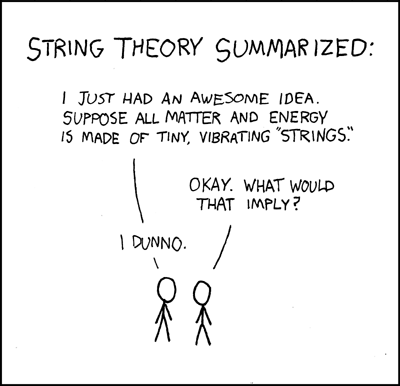
The Sex of String Theory & 3 Questions for her...


Dialogue at the 1998 gathering of Pastors Promise Keepers Atlanta...largest gathering of pastors in one place in history:

Rev. Kevin ("Topless Beach Bum"..story told in
" God, beach and breasts" ) Clancey:
"Is this the Fourth Great Awakening, or just a bunch of pastors getting together?"


Me: "Yes."


As we move even more into this current, and unsettling churchwide Reformation/Reorientation/Awakening;
it is obvious we have lots to learn from the current and unsettling Reformation/Reorientation/Awakening
in physics.

Same thing; mas o menos.

The attraction of string theory (the scientific theory, not the band) is that it offers a practical paradigm for a potential "Theory of Everything," something that even a literal Einstein glimpsed, but could not reach in his lifetime.

Maybe Brian Greene and gang are Joshua to Einstein's Moses.
Hmmm, "subtle is the Lord," indeed.

To get a sense of string theory via Brian Greene, you can "watch" his book" The Elegant Universe") on YouTube?PBS here;

or for a hilarious quickie,

see his hilarious quick interview with Stephen Colbert here below.
String theory is also cool enough to


have "her" own MySpace (become her friend, or she may vaporize you into a black hole) website. And whether it's (she's) right or not, it may be "not even wrong."

As Karl Marx once said, and as Jesus...independently of Marx (: .... seemed to tell me,
"Nothing is more practical than theory, (and nothing is more theoretical than practice)."


But you may know the apparent dilemma; as summarized by Greene:

For many years, physicists found that the central obstacle to realizing a unified theory was the fundamental conflict between the two major breakthroughs of twentieth-century physics: general relativity and quantum mechanics. Although these two frameworks are typically applied in vastly different realms-general relativity to big things like stars and galaxies, quantum mechanics to small things like molecules and atoms-each theory claims to be universal, to work in all realms.Link However, as mentioned above, when the theories are used in conjunction, their combined equations produce nonsensical answers....Calculations...simply show that the combined equations...have gone haywire."
-Brian Greene, "The Fabric of the Cosmos," p. 16

I am guessing I am not the first to ask (but can't hurt to ask) if that apparent haywire is actually "OK"; or to be expected....or not truly haywire. What of the "nonsense" answers actually and ultimately make sense, or are super-sensible/suprasensible/surrational? If there are indeed multiple dimensions, might there not also be parallel ways/means of doing math, so that these "nonsense" equations only "tilt" the pinball game because of the way we are looking at them?

What if the "fundamental conflict" is not fundamental/foundational at all, but only relative..in a quantum kinda way, of course (:

Studies in synesthesia and nueroscience suggest much that appears fundamentally non-sensical
makes more sense than common sense.

A reading of "The Divine Voice,"an amazing theological acoustemology, might even suggest that the primacy of sound would connect with superstring theory (summarized by Len Sweet as "the universe at base is music" ...or sound. See Sweet's seminal "Summoned to Lead"). We need to interpret data through sound sense..pun intended..more that common sense...

or "math as usual" sense.

Comic relief:

Q.Did you hear the one about the constipated mathematician?
A. Yeah, he worked it out with a pencil.


Second question...in light of the following thoughts by Greene...and just replace "third revolution" with "third reformation," small/quantum" with "small Kingdom gatherings" and "large/general relativity" with "large Kingdom gatherings", "independent" with "apostolic networks", etc:


If I were to hazard a guess on future developments, I'd imagine that the background-independent techniques developed by the loop quantum gravity community will be adapted to string theory, paving the way for a string formulation that is background independent. And that's the spark, I suspect, that will ignite a third superstring revolution in which, I'm optimistic, many of the remaining deep mysteries will be solved....I believe that such a (union)...between general relativity and quantum mechanics would yield a gratifying resolution..."
-Greene, 491


...Why in the world (universe?) don't we appropriate the findings of physics even more? In any number of areas imagined above...and also including time travel (a basic definition of The Kingdom in Hebrews 6:1-4..see "THE KINGDOM’S RETROACTIVE RETROFUTURE: SEND ME MORE ARROWS")
Thank God for Kester, Len H., Len S. and tribesters. But the tribe must increase! And embrace Margaret Wheatley and Bono the physicist...

...and Bono's friend Christopher Nolan!

Why in the...heck/hell/quantum dimensions...did the non Christian physicist have to write the book "The Physics of Christianity"?!

THAT's emerging, baby.

Third question:

If you have been brave or bored enough to read this far, aren't you ready for a bad string theory joke (click here)..or the video, "Can String Theory Detect God?" ..one person's attempt to put (Scriptural) chapter and verse to string theory):


"If my thesis is correct...Christianity will become a branch of physics."
-Frank Tipler

Friday, December 03, 2010

The Meaning of History

First, a full confession:
(I haven't confessed publically much since this previous shocker, so I am overdue(:...)

I like to be ironic about irony.
I am dualistic/Hellenistic about my reaction to dualism/Hellenism.

Having said that, and seeing no further need to qualify my qualifier (except to St. Steve, who actually said something like "Dave, you are the most Hellenistic thinker I have ever met!," seemingly unaware of the irony of the statement, even if he was right!), I launch into a book review (of sorts) of  Ronald Nash's "The Meaning of History."  He makes the case that a linear view of history is the correct model, so my review will inevitably be nonlinear.

I have an aversion to verse-itis.
I hate the seduction of reductionism
I am apologetic about any use of apologetics.

But I unapologetically love the book...even though I didn't want to.
I don't necessarily see Nash selling out to any of those paths.
Mostly, he is limited by the very medium (which becomes, and here becomes {see dictionary definition #2}, the message)
             a short introduction (!) to the meaning of history.
Facing an impossible job, he has done wonderfully well.


The basic idea is to introduce us to the speculative history of speculative history, via a comparison of the cyclical view with a linear view (specifically, a Christian view and worldview), and  then through a succinct summary of representative figures of  the philosophy of history: Augustine, Vico, Kant, Herder, Marx and Spengler/Toynbee..
and all with an apologetic edge; offering the Christian worldview, which Nash defines as linear as opposed to cyclical.

Thoughts:

1)For all the risk of reductionism, it may be the best place for the general (Christian) reader to start on the topic. Nash also offers that it also "a good place...for slightly advanced students of the subject to check their previously acquired opinions" (p. x).   I also appreciated his ability to avoid a cheesy "we must train our young people to recapture a Christian worldview" as he discusses how important worldview ("conceptual system") is; and reminds us that everyone inevitably operates from one, and that worldviews are inherently religious.  It was somewhat surprising (and refreshing) to read  an evangelical saying in print that "Paul Tillich was right."  Though Nash  is quick to nuance:
"Paul Tillich is right when he defined religion as a matter of 'ultimate concern'...Religion is more than this, but it cannot be less."  (27).  His chapter on worldview reminded me of VanderLaan's quote that "every story has a pricetag."

2)The chapter on Hegel is hugely helpful. Nash makes the case that Hegel is widely misunderstood
as the thesis>antithesis>synthesis triad.  Nash notes that Hegel himself never directly used those three words together, and when he  did encounter what would today be popularly considered the basic Hegelian view of the triad, he explicitly rejects it (see Hegel's preface to  Phenomenology of Mind)!
Hegel is not very Hegelian at some points!  (and don't blame Calvin for all things branded Calvinism...ditto for
SK et al). The issues raised in the process  of deconstructing and reconstructing Hegel are also key in grasping
a) what Hegel intends to connote by  aufhebehn (synthesis) and Geist  (Spirit/World Spirit/Mind/God)
b)the centrality of self-consciousness and freedom to Hegelian thought.

3)I'm half-kidding (and reductionistic again) to say that Hegel comes off sounding Calvinist and EmergentPentecostal in Nash's reading:

In Nash's description, Hegel's God (even though Nash makes clear that Hegel does not believe in the classic Christian God, or see God as a person/personal, or even consider himself a theist...all points I would love to hear Larry Wood challenge Nash on)  sounds almost like the extreme Calvinist, determinist version, where there is no need for theodicy, as anything that happens is justified, as it somehow leads to the ultimate  Sovereign Synthesis  (Romans 8:28ish)

Where does he sound Emergent-Pentecostal?  "Humans  can particpate in Spirit..and when  they act freely, they advance self-consciousness in their nation.. (112)  Even tough  Nash charges Hegel with "disdain for individual persons"  (114), Hegel's crucial role for "heroes" ("World Heroes") sounds parallel to what Pentecostals would call prophetic or apostolic people.
World heroes seem to be called to catalyze and kickstart synthesis and shift.

But we're back to hyperCalvinism again (must have been predestined!) as such heroes, though using their freedom to tap into how Spirit is leading, are "pawns."  (:


4)Since I am a fan of (literally, on facebook of the "holy helix" view of life/history (and trips up the Andes which seem sickeningly cyclical but have profoundly "elevated" goals)...I would love to hang out with Nash, and ask him, "Does history have to be strictly linear to have a meaning and  goal?"  Then we can bring in George Eldon Ladd and John Wimber (dreaming, as all three: Nash, Ladd, Wimber have died) and talk about the arrow of time, and nonlinear linearity  in the Kingdom (see "THE KINGDOM’S RETROACTIVE RETROFUTURE: SEND ME MORE ARROWS")..
I'll have to stick (for now) to scribbled notes on page 6, where Nash seems (?)  to suggest that we must adopt a reductionist view of linearity as the key to understanding history Christianly (see also p, 159_.

4)I certainly was not expect a proposed solution to the authorship mystery of The Book of Hebrews to show up in the book at all, let alone to be so pivotal to the flow that a whole chapter  (4) is dedicated to the suggested writer...Apollos..being "the first Christian philosopher).  Nash makes the case that the argument of Hebrews assumes an author familiar with (from experience), and arguing against, a Philo -tainted, and Alexandrian-infected  (read circular/cyclical) view of history.  Check it out  in Chapter 4 (though, maddeningly, a huge teaser for "the first Christian philosopher" in the book's introduction [page 4] mistakenly suggests this unveiling happens in Chapter 5....... the only typo/editing mistake I found in the whole book, pretty rare)

5) A format criticism:  The book has no concluding chapter.  It ends with a chapter on the New Marxism.
That seems bizarre, even impossible for an apologetics kind of book...until you realize there indeed is a brief concluding section, but it will never be found by the causal reader, as it is part of the final chapter on the New Marxism.

Oh, my..am I becoming far too modern, RRWI and linear that I would complain about that (:
What would S.  Steve say about me.
(Please don't answer that, Steve.  I've already confessed.....Just read "The Meaning of History at St. Arbuck's..in 3 Easy Strands").

Tuesday, January 20, 2009

new U2 song: The Sound of Watchman Nee's Girly Boots From the Future

Of course, many want to know what I think about the new single by

The answer, as always, has to be a combination of

1)I love it (I mean, it's U2. There's only one song of theirs I really don't do)
2)I don't know yet (I am just now beginning to appreciate the first single from the last album in a new way!!)

Some thoughts so far on "Get On Your Boots," before debuting (for a few of you) the audio and lyrics at the bottom of the page:

1)Glad for the new vibe..and/or old vibe.
The many comparisons to "Actungopapop" (90s U2),
as well as Dylan's "Subterrannean Homesick Blues," Elvis Costello's "Pump It Up"
and (unfortunately) an old song many are claiming it was lifted from.
.
are all partly true..

but so are (partly) the comparisons to Talking Heads, Toby Mac (first thing my son said at the "Let me in the sound" outro) and ...(gulp)Brittney Spears..


2)Lyrically, it feels like..
among other things, as always..

prayer or pray-able
(which the last section spells out).

Maybe it's a prayer that we would be open to how God is wanting to use any who desire to be used...

particularly prophetic women....

in this next season of the world/wineskin/economy/emergence to move us beyond culture wars, gender wars and literal wars ("wars between nations)."


On the women leading the way, I amen it
(see "Banning Women/Missional Chicks");
I think the whole song might even be midrash on Bono's speech to the Women's Conference :

...but I do lament that "sexy boots" can sound, well, sexist. I think however, the sexiness is related to Bono's frequent comments about the unsexiness of justice issues and social action...
I guess if one issues a call to war against war ("Sunday Bloody Sunday" as a violent/militant anthem to peace/pacifism, etc etc), the best image/imagery to invoke must be subversive, too:

war boots aren't usually sexy.
On the boots, this post I did was a spoof, but I can't help but wonder of Bono was tracking with the Isaiah 9:6 use of boots.

I am intrigued by the seguing/splicing (Beth is hilarious here: "It's the JEDP theory of U2!")
onto the end of it the whole "Let me in the sound/God, I'm going down/drown" psalm of supplication.

onto the end the whole "Let me in the sound/God, I'm going down/drown" psalm of supplication.
Matt McGee has called attention to the drowning man motif throughout the U2 canon; Beth picks it up here:


I had never seen that article on drowning imagery by Matt, and it's quite interesting. It also brought the line "lookin' for a sound that's gonna drown out the world" to the forefront of my mind -- there's another abstract "sound" like the one in the GOYB chant, and "drown" is right there both times. Whatever that means.

I have a theory, as I think you know, that the title "Drowning Man" is a Watchman Nee reference drawn from a memorable use of drowning as a spiritual image in his "The Normal Christian Life." Would be interesting to see how Matt would factor that one in to his article.
Beth


I have to wonder how many U2 songs are still wrestling with his mom ,
Jesus, Shalom, and Watchman Nee.
Maybe as many as all.
The "sound" to me is:

  • the musical sound Bono has often mentioned "looking for a sound to drown out the world."
  • a reference to string theory ("The universe is at base, sound/music" (Len Sweet), and thus:
  • a cry to be let into God's sound/voice/strings at its very creation, core, and chaotic creativity. (see "The Divine Voice,"an amazing theology of sound, and Sweet's seminal "Summoned to Lead"). Perhaps we can only hear/see God's voice/sound when we pray/act in holy synesthesia...some amazing biblical precedence there.
This "sound" prayer may well be the answer to Switchfoot's complaint that in our day and age, "Nothing is Sound."

Satan loves to drop bomb and soundscares here,
but they can't scare godly men and sound women.

In the sound of God's sound,
even in the deep waters of a sound (as in "Long Island Sound") one is drowning in,
everything is sound.

Let me in, too.

By the way that "women of the future" seem to get God's sound/revelation.
of course,
such women are fundamentally FROM the future
(see emotional music from a creative future,
and
THE KINGDOM’S RETROACTIVE RETROFUTURE: SEND ME MORE ARROWS

and recall Bono's African prophecy (the only I time I find where Bono specifically claimed to be prophesying) about/from the future:

I'm an artist not a politician. But I prophesy that what was once impossible is possible. I prophesy that I will probably drink one too many red wines this evening. I'm sure, maybe, some people might dance on the tables.

'I prophesy that a day is coming when there will be no HIV.

'I prophesy that this jewel of a kingdom is soon to become a giant.

'Colin Powell once said that the greatest weapon of mass destruction is a virus called HIV. But no WMD could break the spirit I feel in this room. God is in the house, I feel.'

.. 'The future is here. Didn't you feel it?'
link

That prophecy may well be what "Boots" is all about fulfilling.
On to the song (official lyrics and audio here):

The future needs a big kiss
Winds blows with a twist
Never seen a moon like this
Can you see it too
Night is falling everywhere
Rockets at the fun fair
Satan loves a bomb scare
But he won’t scare you
Hey, sexy boots
Get on your boots, yeah
You free me from the dark dream
Candy floss, ice cream
All our kids are screaming
But the ghosts aren’t real
Here’s where we gotta be
Love and community
Laughter is eternity
If joy is real
You don’t know how beautiful
You don’t know how beautiful you are
You don’t know and you don’t get it, do you
No, you don't know how beautiful
You don't know
You don’t know how beautiful you are
That’s someone’s stuff they’re blowing up
We’re into growing up
Women of the future
Hold the big revelations
I got a submarine
You got gasoline
I don’t want to talk about
Wars between nations
Not right now
Hey sexy boots, yeah
No, no, no
Get on your boots, yeah
Not right now
Bossy boots
You don’t know how beautiful
You don’t know how beautiful you are
You don’t know and you don’t get it, do you
No, you don't know how beautiful
You don't know
You don’t know how beautiful you are
Sexy boots
I don’t want to talk about
The wars between the nations
Sexy boots, yeah
Let me in the sound
Let me in the sound
Let me in the sound, sound
Let me in the sound
Let me in the sound
Let me in the sound, now
God, I’m going down
I don’t wanna drown now
Meet me in the sound
Let me in the sound
Let me in the sound
Let me in the sound, sound
Meet me in the sound
Get on your boots
Get on your boots
Get on your boots
Yeah hey hey
Get on your boots
Yeah hey hey
Get on your boots
Yeah hey hey
Get on your boots
Yeah hey hey

Friday, May 25, 2012

the godly idolatry of systematic theology... in 5 easy "R"s

Since all theologizing is

 God-inspired

 and

demonically infused..

                ... it's a tough  but necessary minefield to (circum)navigate.

In a way, it's our only job (we can't NOT theologize).
In  a way it's eventually ( inevitably?) idolatry.

It's a  Catch 22
(Numbers 22, perhaps...remember something in that chapter about talking asses?)


And if  theology is in essence  translation..

                                   then like translation, it can be messianic and betrayal.

Or worse: messianic betrayal.

But..

 if all theology is written by Judas anyway...

                       ...we might as well prayerfully and carefully take a stab at officially doing it.

But in what form/format?
How to do so in way that serves the present age...and  betrays it?

At risk of sounding like an annoying and alliterating preacherman...

If we had to write a systematic theology textbook..

How about starting with a chapter entitled one of the following:

  •  Radiohead
  •  Revelation
  •  Redemption
  •  Random
  • Relevant

Heck, those might even be the only five chapter titles you  need!
(Sorry for the alliteration..but at least I didn't do three points...and a poem.
Scott the  Spy  noticed that even Mr. Emergent himself tends to write in threes..see here.
(I hadn't caught that..we need more spies in the Kingdom...who pro-phetically see what no one else sees).

Oops,  let's back up. It's all still too systematic...we need first and foremost to think systemic.

It's something we all naturally do, but we have been trained/brainwashed that systematic is the only way to fly.

Of course, systemic thinking can also lead  and breed to idolatry, but it is more innate, intuitive...and like life and like  Theos himself.
(Of course it opens a door to heresy...do it anyway!)


I DO love teaching "Systematic Theology"..had a great time with these tribesters at Latin American Bible Institute, for example.
We walked through the required systematic theology textbook..

But we walked  and talked in a way that was

                                                                   systemic,
          organic,
       interrelated,
\                                       networked,
 muliplex
                                                                                            and Venned.

As our churchthing family has  been  recently praying for our  Chilean member , the poeta Happy Lee,  who has started a seminary systematic theology course,  I thought to take these two photos to tease her a bit..


First photo came with the comment "Here's my systematic theology  bookshelf (look how it's literally so heavy, it's weighed down) If you need to borrow anything, I 'll be glad to email a book or three to you."

Then I caught the book title in the second photo.

Ideally it could replace and render obsolete all the more "theological" titles behind it.
(Though you'll notice it was written by Jerry Jenkins, so inevitably it must be left behind)

Of the making of books there is no end,
but if our end was to make ONE book on systemic theology

We must mess with the mold.

RADIOHEAD

Pick a lyric/line anywhere in their canon/cannon.
Or stick to one album..or one song..like "Airbag""


  • "Like a jackknifed juggernaut, I am born  agaaaaaaaaaaaaaain" (salvation)
  • "In an interstellar burst, I'm back to save the uuuuuuuuuuuuuuniverse"  (Second Coming).


More?  See all my posts on Radiohead. or start here:


Or...as my character said to Ken's character in the award-winning "Gaithers on Crack" film embedded below: "Radiohead!!  Any questions?"

REVELATION

Why do most books follow the nice and neat narrative:
God>humans> Jesus> end times  etc

And why can't the chapters be

 venned
              hyperlinked

                                       interlocked


.............not

sysetematic-ized:

segmented,
               cemented,
                                      walled off..
There are no chapter divisions in the Bible, so why book them for  a theology book?

I love how folks like Rob Bell and Len Sweet have put table of contents in the back, for example.
It helps us think from right to left...which is the right way, by the way.

I love how McLaren took on the Greco-Roman narrative that had held us captive.

(see "A New Kind of Christianity" McLaren  and holy heteroclite:: "A New Kind of Christianity" review part 2:).
His alternative flow is excellent and exhilirating..but also just as much a grid or system as any other!  (as is mine..or anyone's...How do we put a lock in grids..and gridlock? Awareness is half the battle..)

SOO...at great risk...why not start  at the beginning.
By that I mean with the book of  Revelation.. and work backwards (forwards and forewords) from there.
Not in the Left Behind way.
But in a way that gets the flow of Kingdom  and eschatology.
And that goes with that flow....and flows with the "go":


Try these links for starters (enders):


REDEMPTION

Okay, I chose the R word, only to be consistent.
I mean atonement.

Rethink/dethink/atone for all atonement theories.

Abandon all atonement theories...theoretically.

There are no theories of atonement.
That's a good theory of atonement.

Or at least draw/systematize all such theories from Jesus' life as much as his death.

That includes his life before his life (preincarnate)
and his current life.

Ask 10 out of 10 Christians to fill in the blank:

"The Bible says we are saved by the ________ of Jesus."

11 out of 11 will say "death" (or resurrection.)
Romans 5:10 says...


 LIFE..

 I sometimes draw this chart to suggest that atonement theories
shouldn't just deal only with  Jesus' death and resurrection,  but also branch out to draw  from  his  birth, life and teaching on one end...

...and include  ascenscion and Pentecosting on the other end.
NT Wright has recently reminded us of the   ridicubulous lapses in the creeds:


The creeds were drafted in order to highlight points on which the church resolved major difficulties. But when the creeds began to be used as a teaching syllabus (as they often are to this day), then the problem begins, because of course the creeds jump straight from Jesus’ birth to his death … and I have a mental image at that point, of Matthew, Mark, Luke, and John standing there saying ‘Excuse me, we spent a lot of time and effort telling you about all that stuff in between, and you just skip over it?  What’s that about?’
Now, I have nothing against the great creeds.  I love them, and I say them or sing them ex animo.  But they have accidentally encouraged—or the way they have been used has accidentally encouraged—a reading of the New Testament in which the main body of the four Gospels is not theologically load-bearing.  For many Christians, it would have been quite sufficient if Jesus of Nazareth had been born of a virgin, died on a cross, and never done anything in between except, perhaps, lived a sinless life.
The four Gospels then, function for many as the dispensible back story for the Gospel as preached by Paul … this is the de facto position of many Protestants and many Evangelicals—many conservativeEvangelicals—the irony being, of course, that it’s the exact same position as that of Rudolph Bultman, with the only difference being that Bultman thought most of the stories were pious fictions.  But the reason why most Evangelicals would differ is not that the stories are doing anything theologically, in themselves, but simply to shore up a view of the inspiration of Scripture.  Not for the only time, swaths of Evangelicals are more anxious to protect a theory of Scripture, than to hear what Scripture actually says.  LINk


RANDOM

Write that book.

BUT..

Subvert the dominant Greco-Roman narrative.

Start somewhere random...
as nothing is random...........and there is a  wholly and holy randomnity.

Heck, there may even be a  "Random Designer":reigning  randomly in  an ordered heaven.

How random is that?


RELEVANT

I hate that word.

Let's go with practical..

Remember that God loves donkeys, sweat, entrails and menstruation:


'Practical' Theology departments at seminaries do not make theology more practical. They ensure that theology, oustide the PT department, will remain practical--that it will remain theology..
..Theology is bad enough, but modern theology is theology cultivated into idolatry. Bowing before science, social science, or philosophy, modern theology has adjusted its distinctive language and insight to conform to the common sense of modernity. Metaphysics or evolutionary science or liberal political theory or whatever determines in advance what can be true of God and His ways. . .
Theology is a specialized, professional language, often employing obscure (Latin and Greek) terms that are never used by anyone but theologians, as if theologians live in and talk about a different world from the one mortals inhabit.
Theology functions sociologically like other professional languages - to keep people out and to help the members of the guild to identify with one another.
Whereas the Bible talks about trees and stars, about donkeys and barren women, about kings and queens and carpenters....
...Theology is a "Victorian" enterprise, neoclassically bright and neat and clean, nothing out of place.Whereas the Bible talks about hair, blood, sweat, entrails, menstruation and genital emissions.
Here's an experiment you can do at any theological library. You even have my permission to try this at home..
Step 1: Check the indexes of any theologian you choose for any of the words mentioned above. (Augustine does not count. Augustines' theology is as big as reality. Or bigger.)
Step 2: Check the Bible concordance for the same words.
Step 2: Ponder these questions: Do theologians talk about the world the same way the Bibke does? Do theologians talk about the same world the Bible does?
Peter J. Leithart, Against Christianity, pp44ff


Of course...on the topic of keeping theology relevant/practical..

everyone should read a book with a terrible title that makes it sound heavy and heady.

It is.

But impossibly...it is also really real, relevant.

It's practical, actual and factual.

And the centerfolds rock.

----

Anyway, hope that made Happy happy.
Hope that messed up everyone's day, hair, and theology.

I hope we are all inspired to go forth and do what we shouldn't do but do do:

                                            Theologize.

Counter systemic evil with sytemic theology...and Theos.
Just make sure it all connects somewhere with the real world:
Jesus in/on the street corner.

If it stays in Ivory Tower, and never hits (or starts) with the man on the street, or the streetwalker..
..it's worse than a clanging cymbal/symbol....