"Do not depend on the hope of results … you may have to face the fact that your work
will be apparently worthless and even achieve no result at all, if not perhaps results
opposite to what you expect. as you get used to this idea, you start more and more to
concentrate not on the results, but on the value, the rightness, the truth of the work itself. …you gradually struggle less and less for an idea and more and more for specific
people. … in the end, it is the reality of personal relationship that saves everything."
-quoted in Margaret Wheatley, "The Place Beyond Fear and Hope" PDF
Showing posts with label margaret wheatley. Show all posts
Showing posts with label margaret wheatley. Show all posts
Wednesday, November 23, 2011
"Do not depend on the hope of results"
Thomas Merton, to a friend:


Wednesday, October 07, 2009
Margaret Wheatley videosL Healthy Community Change
"Ten Principles of Creating Healthy Community Change"
The short episodes will play automatically once you start watching below
(or to choose an episode, click here.).
(Note: the tenth episode is missing)
Background on Wheatley's award-winning leadership book on chaos and disorder:
The short episodes will play automatically once you start watching below
(or to choose an episode, click here.).
(Note: the tenth episode is missing)
Background on Wheatley's award-winning leadership book on chaos and disorder:
Wednesday, May 14, 2008
The Sex of String Theory & 3 Questions for her...

Dialogue at the 1998 gathering of Pastors Promise Keepers Atlanta...largest gathering of pastors in one place in history:
Rev. Kevin ("Topless Beach Bum"..story told in " God, beach and breasts" ) Clancey:
"Is this the Fourth Great Awakening, or just a bunch of pastors getting together?"
Me: "Yes."
As we move even more into this current, and unsettling churchwide Reformation/Reorientation/Awakening;
it is obvious we have lots to learn from the current and unsettling Reformation/Reorientation/Awakening
in physics.
Same thing; mas o menos.
The attraction of string theory (the scientific theory, not the band) is that it offers a practical paradigm for a potential "Theory of Everything," something that even a literal Einstein glimpsed, but could not reach in his lifetime.
Maybe Brian Greene and gang are Joshua to Einstein's Moses.
Hmmm, "subtle is the Lord," indeed.
To get a sense of string theory via Brian Greene, you can "watch" his book" The Elegant Universe") on YouTube?PBS here;
or for a hilarious quickie,
see his hilarious quick interview with Stephen Colbert here below.
String theory is also cool enough to
 gang are Joshua to Einstein's Moses.
Hmmm, "subtle is the Lord," indeed.
To get a sense of string theory via Brian Greene, you can "watch" his book" The Elegant Universe") on YouTube?PBS here;
or for a hilarious quickie,
see his hilarious quick interview with Stephen Colbert here below.
String theory is also cool enough to
have "her" own MySpace (become her friend, or she may vaporize you into a black hole) website. And whether it's (she's) right or not, it may be "not even wrong."
As Karl Marx once said, and as Jesus...independently of Marx (: .... seemed to tell me,
"Nothing is more practical than theory, (and nothing is more theoretical than practice)."
"Nothing is more practical than theory, (and nothing is more theoretical than practice)."
But you may know the apparent dilemma; as summarized by Greene:
For many years, physicists found that the central obstacle to realizing a unified theory was the fundamental conflict between the two major breakthroughs of twentieth-century physics: general relativity and quantum mechanics. Although these two frameworks are typically applied in vastly different realms-general relativity to big things like stars and galaxies, quantum mechanics to small things like molecules and atoms-each theory claims to be universal, to work in all realms.However, as mentioned above, when the theories are used in conjunction, their combined equations produce nonsensical answers....Calculations...simply show that the combined equations...have gone haywire."
-Brian Greene, "The Fabric of the Cosmos," p. 16

I am guessing I am not the first to ask (but can't hurt to ask) if that apparent haywire is actually "OK"; or to be expected....or not truly haywire. What of the "nonsense" answers actually and ultimately make sense, or are super-sensible/suprasensible/surrational? If there are indeed multiple dimensions, might there not also be parallel ways/means of doing math, so that these "nonsense" equations only "tilt" the pinball game because of the way we are looking at them?
What if the "fundamental conflict" is not fundamental/foundational at all, but only relative..in a quantum kinda way, of course (:
Studies in synesthesia and nueroscience suggest much that appears fundamentally non-sensical
makes more sense than common sense.
A reading of "The Divine Voice,"an amazing theological acoustemology, might even suggest that the primacy of sound would connect with superstring theory (summarized by Len Sweet as "the universe at base is music" ...or sound. See Sweet's seminal "Summoned to Lead"). We need to interpret data through sound sense..pun intended..more that common sense...
or "math as usual" sense.
Comic relief:
Q.Did you hear the one about the constipated mathematician?
A. Yeah, he worked it out with a pencil.
or "math as usual" sense.
Comic relief:
Q.Did you hear the one about the constipated mathematician?
A. Yeah, he worked it out with a pencil.
Second question...in light of the following thoughts by Greene...and just replace "third revolution" with "third reformation," small/quantum" with "small Kingdom gatherings" and "large/general relativity" with "large Kingdom gatherings", "independent" with "apostolic networks", etc:
If I were to hazard a guess on future developments, I'd imagine that the background-independent techniques developed by the loop quantum gravity community will be adapted to stringtheory, paving the way for a string formulation that is background independent. And that's the spark, I suspect, that will ignite a third superstring revolution in which, I'm optimistic, many of the remaining deep mysteries will be solved....I believe that such a (union)...between general relativity and quantum mechanics would yield a gratifying resolution..."
-Greene, 491

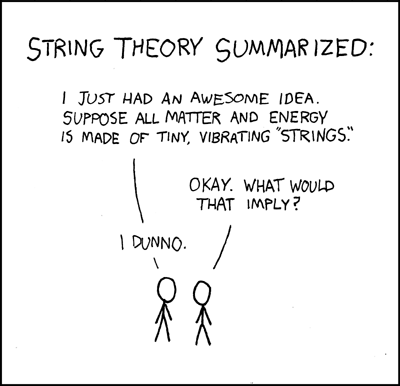
...Why in the world (universe?) don't we appropriate the findings of physics even more? In any number of areas imagined above...and also including time travel (a basic definition of The Kingdom in Hebrews 6:1-4..see "THE KINGDOM’S RETROACTIVE RETROFUTURE: SEND ME MORE ARROWS")
Thank God for Kester, Len H., Len S. and tribesters. But the tribe must increase! And embrace Margaret Wheatley and Bono the physicist...
...and Bono's friend Christopher Nolan!
Why in the...heck/hell/quantum dimensions...did the non Christian physicist have to write the book "The Physics of Christianity"?!
THAT's emerging, baby.
Third question:
If you have been brave or bored enough to read this far, aren't you ready for a bad string theory joke (click here)..or the video, "Can String Theory Detect God?" ..one person's attempt to put (Scriptural) chapter and verse to string theory):
"If my thesis is correct...Christianity will become a branch of physics."
-Frank Tipler
Tuesday, February 12, 2008
bizarre surprises are the norm

"For me, the only trustworthy indication that God is somewhere in my prayer is that it suprises me."
-Anne Monroe, "The Word: Imagining the Gospel in Modern America," p.101
"If an idea did not appear bizarre, Heisenberg counseled, there is no hope for it."
-Margaret Wheatley, "Leadership and the New Science: Discovering Order in a Chaotic World" p.105
Saturday, January 26, 2008
Moltmann on Chaos/ Trinity..bonus links to SpongeBob et al
Counterbalance.net summarizes a paper by the amazing Moltmann (one of the most voital theologians/thinkers the emerging church needs to wrestle with
...of course the list includes Margaret Wheatley, Wolfgang Simson, Fr. Robert Farrar Capon, Frank Zappa, Annie Dillard, Joao Magueijo, Bono, Frost/Hirsch , Radiohead, Malcolm Gladwell , XXXChurch.com and SpongeBob...):
Moltmann, Jurgen. “Reflections on Chaos and God’s Interaction with the World from a Trinitarian Perspective.”
In his paper, Jurgen Moltmann first describes five models of the God-world relation: (1) According to the Thomistic model, God is the causa prima of the world. God also acts through the causae secundae which serve as God’s instruments. (2) The interaction model postulates a degree of reciprocal influence between God and the world. This model can include the Thomistic model, but not vice versa. (3) The whole-part model, taken from biological systems theory, emphasizes that the whole is more than and different from its parts. In complex and chaotic systems this difference shows up in the form of top-down causality. The whole-part model is more inclusive than the previous models and sheds light on God’s indirect effect upon the world as a whole. (4) The model of life processes emphasizes the open character of biological systems. The present state of a living system is constituted by its fixed past and its open future or, more generally, by what can be called tradition and innovation. Here the world process is open to God as its transcendental future. (5) Finally, Moltmann considers two central theological models: creation and incarnation. Here God creates by a process of self-limitation (or tzitzum). The limitation on God’s omnipresence creates a habitation for the world; the limitation on God’s omniscience provides the world with an open future. God’s self-limitation allows God to be present within the world without destroying it. Moltmann believes this model is the most inclusive of the five.
Moltmann next offers three comments on how these models function in current theological discussions about chaotic, complex and evolutionary systems.
(1) He is critical of the interaction model, seeing it as a theistic model in which God is the absolute Subject who may intervene at will in nature. In the modern period it was replaced by two even more problematic models: deism and pantheism. In their place Moltmann commends to us a trinitarian model in which “God the Father creates through the Logos/Wisdom in the power of the Holy Spirit. . . . God not only transcends the world but is also immanent in the world.” According to this model God acts upon the world through God’s presence in and perichoresis with all things.
(2) Next Moltmann discusses eschatology, the new creation of all things. For Moltmann the future is not a state of completion but a process of continuing openness, in which all finite creatures will participate in God’s unending and open eternity even as God participates in their temporality. The openness of chaotic, complex, and evolutionary systems is suggestive of this vision, and seems inconsistent with a future conceived of as completed. “The future of the world can only be imagined as the openness of all finite life systems to the abundance of eternal life. In this way they can participate in the inexhaustible sources of life and in the divine creative ground of being.”
(3) Finally Moltmann asks whether the universe as a whole should be thought of as an open system. The growth of possibilities for such systems, their undetermined character, and their dependence on an influx of energy suggest that the universe itself might be open to energy. “In this case the world would be a ‘system open to God’ and God a ‘Being open to the world.’”
Tuesday, October 16, 2007
Context is Everything: Programmed by Books we haven't read
I am glad St. Mackan asked about my post a few days ago which consisted only of an out of context quote, I wanted to provide the context, and here it is.
As we say here in the States, Mackan: "My bad."
My amazing professor Bob Lyon always said, and the MacMan (who even put it on a T shirt...cool!) still doth say:
"Context is everything."
The paraphrased quote at hand(by another seminary professor of mine):
The context:
He was specifically lamenting that so many pastors, without even knowing or reading the book that such theology was based on (Richard Baxter's 1656 classic, "The Reformed Pastor"), have adopted/been taught such theology. Namely, and stated extremely, the view is that pastors do all the work, and the laity are just there to listen to you. Hunter recommends that we take a page from another Book that we have hopefully read (The Bible, which makes the priesthood of all believers quite foundational) ; as well as John Wesley's books, which journal well what happens when the so-called "laity" are empowered.
He also applies the "Most of us are programmed by books we never read"principle to other disciplines. A most obvious example is physics: We are still informed by a Newtonian worldview, when Einstein/relativity/quantum theory/string theory has rocked that old mindset. To cross disciplines, this revolution/shift of wineskins in physics holds profound implications for theology , as Len sweet, Len Hjalmarson and Margaret Wheatley have creatively explored.
Every field of study has its seminal textbooks, some hundreds of years old; and most which have a lot to offer and are indeed classic (as Baxter..he got a lot beautifully right). But most have never literally read them; Just been"by default hugely influenced by them (trough their graduate school' s secondary source texts)
"Protestant Christianity's equivalent of Darwin's 'Origin of Species'-for understanding who we are--and Newton's 'Principia'--for understanding our place in the scheme of things,and how the (church) world works--is Baxter" (p.105)
Another way of saying this then, is "The mind can only take pictures using the film with which its been loaded." (quote by Richard Rohr, hat tip to Len).
Basic to a postmodern epistemology is a (healthy) questioning of our lenses and our "texts" (as Derrida used the term, a "text" could be anything, not just a literal book).
It's also a helpful question in overcoming ethnocentrism.
Lord, help us to know how we have been programmed. We may need deprogramming, deconstruction, or even a kick in the butt. Amen.
As we say here in the States, Mackan: "My bad."
My amazing professor Bob Lyon always said, and the MacMan (who even put it on a T shirt...cool!) still doth say:
"Context is everything."
The paraphrased quote at hand(by another seminary professor of mine):
Most of us are programmed by books we never read.
George Hunter, Radical Outreach: The Recovery of Apostolic Ministry and Evangelism ,p. 105
The context:
He was specifically lamenting that so many pastors, without even knowing or reading the book that such theology was based on (Richard Baxter's 1656 classic, "The Reformed Pastor"), have adopted/been taught such theology. Namely, and stated extremely, the view is that pastors do all the work, and the laity are just there to listen to you. Hunter recommends that we take a page from another Book that we have hopefully read (The Bible, which makes the priesthood of all believers quite foundational) ; as well as John Wesley's books, which journal well what happens when the so-called "laity" are empowered.
He also applies the "Most of us are programmed by books we never read"principle to other disciplines. A most obvious example is physics: We are still informed by a Newtonian worldview, when Einstein/relativity/quantum theory/string theory has rocked that old mindset. To cross disciplines, this revolution/shift of wineskins in physics holds profound implications for theology , as Len sweet, Len Hjalmarson and Margaret Wheatley have creatively explored.
Every field of study has its seminal textbooks, some hundreds of years old; and most which have a lot to offer and are indeed classic (as Baxter..he got a lot beautifully right). But most have never literally read them; Just been"by default hugely influenced by them (trough their graduate school' s secondary source texts)
"Protestant Christianity's equivalent of Darwin's 'Origin of Species'-for understanding who we are--and Newton's 'Principia'--for understanding our place in the scheme of things,and how the (church) world works--is Baxter" (p.105)
Another way of saying this then, is "The mind can only take pictures using the film with which its been loaded." (quote by Richard Rohr, hat tip to Len).
Basic to a postmodern epistemology is a (healthy) questioning of our lenses and our "texts" (as Derrida used the term, a "text" could be anything, not just a literal book).
It's also a helpful question in overcoming ethnocentrism.
Lord, help us to know how we have been programmed. We may need deprogramming, deconstruction, or even a kick in the butt. Amen.
Wednesday, July 12, 2006
traditional vs organic structure

Can it be this easy? What keeps the bottom chart from morphing/defaulting/shapeshifting into the top?
Is there any validity to the top diagram? If so, can the charts be combined?
What is the role of a pastor or 5fold leader?
The zillion dollar question: "Can organic church work with a paid pastor?"
(chart from Simple Church)
Helpful guides:
Cole's Organic Church...quotes;
Wimber re: organism and organization; St. Len, Margaret Wheatley; ...you?
Tuesday, April 25, 2006
St. Margaret

There is no way to describe Margaret Wheatley. Tiy can trt terms like "leadership futurist," and "organizational theorist." But the one who introduced me to the power of fractals can only be "St. Margaret" in my book (No matter what she does or doesn't believe..she consults with, and speaks at, churches). Ever since her seminal "secular" book,
"Leadership and the New Science: Discovering Order in a Chaotic World,"
it has become fairly obviou she is a gift to the church. Anyone with articles like
"Consumed by Either Fire or Fire: Journeying with T.S. Eliott," and "Goodbye, Command and Control," ...how could they not be?
Len at NextReformation.com has long drawn on her wisom and applied it to church and Kingdom.
Roger has been commenting on this book at the House Church Blog. He comments at one point:
The author, Margaret Wheatley, describes the inability of our ancient
"Newtonian" science concepts to properly describe our universe. The "old"
science views creation as a machine that can be understood by taking apart each
piece and examining it. This view of life has caused us, for centuries, to
put together control-systems that will organize mechanical systems for the
desired result. She suggests that our understanding of organizational and
leadership models is a direct result of our old way of studying the
universe. The new science, on the other hand, describes a universe that is
not so easily defined or controlled. At the core of the universe is not
some basic "building block" but rather unseen connections between "entities"
that change and are, themselves, fluid. Thus, Wheatley sees our new
understanding of the universe pointing us toward "living sytems" that use "fluid
and organic structures" that possess the "same capacity to adapt and grow that
is common to all of life."
On to the Wheatley book itself:
We seem hypnotized by structures, and we build them strong and complexRhonda Servine did a paper at Fuller on Leadership and the New Science, which she donated to the House Church Blog. The entire paper is here; excerpt below:
because... this is a universe, we feel, that cannot be trusted with its own
process for growth and rejuvenation... By sheer force of will, because we are
the planet's intelligence, we will make the world work...
If people are
machines, seeking to control us makes sense. But if we live with the same
forces intrinsic to all other life, then seeking to impose control through rigid
structures is suicide....
...I want to trust in this universe so much that I give up playing
God. I want to stop struggling to hold things together. I want to
experience such security that the concept of "allowing"--trusting that the
appropriate forms will emerge--ceases to be scary.
Organizations have long been structured like a machine, divided into multiple parts
which have varying functions, and ignoring the human beings which compose it.
The church has also followed this form. But now the key determinant in our world
is being recognized by scientists as relationship, and the consequences of this
are influencing our whole society...
In the new science, the structure of processes and potential relationships
is what is central to being. Relationships determine who we are, how we
think, what we become. We are not isolated machines but are interconnected and
influenced by all with whom we come in contact. The Church as ‘friendship’
and ‘relational conversation’ fits well with this concept; deep relationships
are centered in love, which changes the individual and then the world.
What are you waiting for? Get started yourself:
www.margaretwheatley.com
Subscribe to:
Posts (Atom)