Welcome! You have accidentally reached the blog of a heteroclite follower of Jesus: dave wainscott. I'm
"pushing toward the unobvious" as I post thinkings/linkings
re: Scripture, church and culture. Hot topics include: temple tantrums, time travel, sexuality/spirituality, U2kklesia, role of the pastor, God-haunted music/art..and subversive videos like these.
"Children were sometimes burned alive at Auschwitz ..After describing this scene, Rabbi Greenburg put forward the following proposition: 'No statement, theological or otherwise, should be made that would not be credible in the presence of burning children.". -Gushee. p. 70, After Evangelicalism
Highly recommended: read page 76 (and ideally the whole section of pp. 74-81) of Gushee's After Evangelicalism (readhere) ,where he covers Greenburg's suggestion that post-Holocaust, for the Jews, the covenant is no longer in a "commanded stage," but is now voluntary.
"Israel's relation with God has been severely wounded. Wiesel: ' Only a wounded faith can exist after these events. Only a wounded faith is worthy of a silent God.'...God no longer has the right to demand covenant loyalty from his people." -Gushee. p. 76, After Evangelicalism
"I believed myself above him simply on the basis of my Upper East Side address; like most New Yorkers, I had bought into the mystique of superiority that came as a consolation prize for life in a lonely and harsh metropolis"
The author of the explosive New York Times-bestselling memoir Unorthodox chronicles her continuing journey as a single mother, an independent woman, and a religious refugee. In 2009, at the age of twenty-three, Deborah Feldman walked away from the rampant oppression, abuse, and isolation of her Satmar upbringing in Williamsburg, Brooklyn to forge a better life for herself and her young son. Since leaving, Feldman has
navigated remarkable experiences: raising her son in the “real” world, finding solace and solitude in a writing career, and searching for love. Culminating in an unforgettable trip across Europe to retrace her grandmother’s life during the Holocaust, Exodus is a deeply moving exploration of the mysterious bonds that tie us to family and religion, the bonds we must sometimes break to find our true selves. link
From Greil Marcus'
"ranters & crowd pleasers: punk in pop music, 1977-92":
1. Bob Dylan:  at the Grammy Awards, 20 February 1991.
Thirty years after arriving in New York from Minnesota, Bob Dylan stepped
forward to be honored with a Lifetime Achievement Award.  With the Gulf War in
progress, the blanket of acceptance that had been draped over the show was so
heavy the WAR SUCKS t-shirt New Kid on the Block Donnie Wahlberg wore to the
American Music Awards a few weeks earlier would have been forbidden here;
maybe that's why Dylan sang "Masters of War", from 1963, and maybe that's why
he disguised it, smearing the verses into one long word.  If you caught on to
the number, the lyric did emerge - "And I'll stand o'er your grave/'Til I'm
sure that you're dead" - but lyrics were not the point.  What was was the ride
Dylan and hid band gave them.  With hats pulled down and dressed in dark
clothes, looking and moving like Chicago hipsters from the end of the fifties,
guitarists Cesar Diaz and John Jackson, bassist Tony Garnier, and drummer Ian
Wallace went after the song as if it were theirs as much as Dylan's: a chance
at revenge, excitement, pleasure.  You couldn't tell one from the other, and
why bother?

With this career performance behind him, Dylan took his trophy from a beaming
Jack Nicholson; he squinted, as if looking for his mother, who was in the
audience.
"Well," he said, "my daddy, he didn't leave me much, you know he was a very simple man,
but what he did tell me was this, he did say, son, he said.. - there was a long pause, nervous laughter from the crowd [well, he said so many things, you know. -more laughter]-
"he say, you know it's possible to become so defiled in this world
that your own mother and father will abandon you ; and if that happens,
God will always believe in your own ability to mend your ways."
Then he walked off. He had managed to get in and out without thanking anybody,
and this night it really did seem as if he owed nobody anything.
From: Martin Grossman (tgg@slip.net)
Newsgroups: rec.music.dylan
Subject: Re: 91 Grammy Performance
Date: Mon, 10 Aug 1998 11:16:33 -0400
It seems to me Ronnie Schreiber nailed the source of Bob's Grammy speech
some time ago. Said Ronnie:
At the time of the acceptance speech, I turned to my wife and said that
Dylan's comments were an allusion to Psalms 27:10: "When my father and
mother abandon me, HaShem (G-d) will gather me up."
I went back to the sources and discovered that Dylan's remarks were
almost a verbatim account of the commentary of Rabbi Shimshon Rafael
Hirsch (the spiritual leader of traditional Jewry in Germany in the mid
19th century) on that verse:
"Even if I were so depraved that my own mother and father would
abandon me to my own devices, God would still gather me up and believe
in my ability to mend my ways."
Now, we have no way of knowing if Abram Zimmerman really taught this to
his son or if Bob simply picked it up from a commentary on the Jewish
prayer book (Ps. 27 is recited at the morning and evening prayer
services during the month before the Jewish New Year), but in any case,
the wording is too similar to Hirsch's to ignore. Note how both Hirsch
and Dylan reversed the "father and mother" of the original verse to
"mother and father" and Dylan's use of the phrase "believe in your own
ability to mend your own ways" directly parallels Hirsch's "believe in
my ability to mend my ways".
It's unlikely Dylan's father was familiar with the writings of Rabbi
Hirsch, the 19th Century leader of German neo-Orthodoxy. Dylan's
involvement with Judaism over the past ten or fifteen years has been
mostly through Chabad -- also an unlikely place for him to have been
introduced to the Hirsch commentary. It's more likely Dylan saw the
quote in the Metsudah Siddur, a prayerbook popular among Baalei Tshuvah
(as "returnees" to orthodox Judaism are know, although many of them are
encountering serious Judaism for the first time). The lines from Hirsch
are cited in the Metsudah commentary and represent its translation from
Hirsch's German. And we can speculate that it's their language that
Dylan echoes.
Note from MG: By attributing the words to his father, Dylan is following
a long tradition of attribution in Judaism. He can be said to be using
"father(s) in a wider sense, meaning his heritage.
--
Martin Grossman
It took him less than a minute, even with his nervous hat fumbling and pauses, but Dylan had just delivered an Old Testament sermon (Psalm 27:10) about the disfigurement of a life spent enslaved to the material things to the bejeweled, genial, war-applauding, music millionaire crowd.
Here is the speech:
There is a rich history of commentary in Jewish tradition. There is also a rich history of commentary in interpreting Bob Dylan’s every public utterance. Psalm 27 begins (in the King James Version): “The LORD is my light and my salvation; whom shall I fear?” In King James, verse 10 reads, “When my father and my mother forsake me, then the LORD will take me up.”
Where does “defiled” come from? “Mend your ways?” A couple Dylan interpreters suggest that his language is straight out of the works of one the founders of Orthodox Judaism in the 19th Century, Rabbi Samson Raphael Hirsch. Hirsch’s commentary on the psalm verse reads: “Even if I were so depraved that my own mother and father would abandon me to my own devices, God would still gather me up and believe in my ability to mend my ways” (Yaffe, Bob Dylan: Like a Complete Unknown, Yale UP). As David Yaffe, the author of the Hirsch discovery points out, Dylan in the late-’80s and early 1990s was a frequent performer on the annual Los Angeles-area Chabad telethons that usually offered entertainment from great (and far older) performers like Norm Crosby, Jan Murray, and Sid Caesar. Perhaps he was reading a lot of scriptural commentary; Rabbi Hirsch is not an obscure figure in that field.
Who better to receive a scriptural pronouncement such as this than a bejeweled, genial, war-applauding Hollywood audience? I am no Talmudic scholar, nor am I a Bob Dylan interpreter, but this is one of the many reasons I enjoy Bob Dylan’s every appearance. link
Thanks to Mark DeRaud for the tip on the post below by JD Walt. Of course, I have taught that according to Joel 2/Acts 2, the last days began at Pentecost.
Peter preaches, and says "What you see is the following; "In the last days....I will pour out my Spirit.."
14 Then Peter stepped forward with the eleven other apostles and shouted to the crowd, “Listen carefully, all of you, fellow Jews and residents of Jerusalem! Make no mistake about this.15 These people are not drunk, as some of you are assuming. Nine o’clock in the morning is much too early for that.16 No, what you see was predicted long ago by the prophet Joel:
17 ‘In the last days,’ God says, ‘I will pour out my Spirit upon all people. Your sons and daughters will prophesy. Your young men will see visions, and your old men will dream dreams. 18 In those days I will pour out my Spirit even on my servants—men and women alike— and they will prophesy. 19 And I will cause wonders in the heavens above and signs on the earth below— blood and fire and clouds of smoke. 20 The sun will become dark, and the moon will turn blood red before that great and glorious day of the Lord arrives. 21 But everyone who calls on the name of the Lord will be saved.’[c]
-- But Mark's comment (based on the Walt post) pushes a huge envelope: "The last days ended with Pentecost." -Mark DeRaud. What do you think? This raises the question about whether verses 19-20 have happened yet? Of course, the party line is that the sun darkening and the red moon are signs of the "end of the end, "and they obviously haven't happened yet. Yet many including NT Wright make the case that this was a symbolic way of speaking of the events of AD 70: destruction of the temple. (see what Wright does with the Isiaah 13:10 sun and moon signs here. See also a couple posts by Kirk
I was talking with a well-meaning leader just the other the other day who began discounting my outlook. He said, "J.D., your view is preposterous. Don't you notice how terrible things really are? Don't you know what the Bible says? 'There will be terrible times in the last days'" (2 Timothy 3:1).
Another man suggested that I was a "scoffer." He said, "Don't you know what Jude, the half-brother of Jesus declared, 'In the last times scoffers will arise who will follow their own ungodly desires' (Jude 1:18). If you don't see things getting worse, you're nothing more than a scoffer - rejecting the Word of God."
Many insist that the Bible foretells disaster and trouble - particularly as we descend into the "last days." They're convinced that, in the grand biblical narrative, cataclysm and destruction are imminent. It seems that there can be no goodness or hope in "perilous times." This kind of worldview is understandable. A superficial reading of the New Testament would suggest the reality that they're asserting. However, things are not always as they appear.
The term "last days" is arguably one of the more misunderstood phrases in the Bible. It is not talking about the end of the world, but the end of the “old covenant” era.
Rather than referring to the destruction of the earth, it is a depiction of the end of the temple, animal sacrifices, and Levitical priesthood. It spoke of the unrest and volatility that would be found at the cessation of a religious order that was, at best, temporal in nature (Hebrews 6:20-8:13).
It might surprise many to hear this, but the writer of Hebrews affirms that the last days were in his lifetime. He declares that the revelation was being received, "in these last days" (Hebrews 1:2). Elaborating on what this meant, he goes on to declare that "Jesus has now obtained a more superior ministry, since the covenant he mediates is founded on better promises" (Hebrews 8:6). The “Last-Days” or “End of the age” is really about the tumultuous transition to the New Covenant order. It is the end of what was and the beginning of something new! It was never meant to be used as an excuse to sidetrack the good news of the gospel. link
of course Christians will be left behind NT Wright and Barbara Rossing..
Here's Benjamin Corey, who builds the case from Luke:
Jesus Says Those “Left Behind” Are The Lucky Ones (the most ironic thing the movie won’t tell you) by Benjamin Corey:
In
the lead up to the release of the remake of Left Behind hitting
theaters in a few weeks, I wanted to take a moment to tell you about the
most ironic thing the Left Behind movie (or rapture believers) won’t
tell you about getting “left behind.”
The
basic premise of the theology is this: the world is going to get
progressively worse as “the end” draws near. Before the worst period of
time in world history (a seven year period called the “tribulation,”
though there’s no verse in the Bible that discusses a seven year
tribulation) believers in Jesus are suddenly snatched away during the
second coming of Christ (which rapture believers argue is done in secret
and without explanation, instead of the public second coming described
in scripture).
The entire premise of
the theology and the Left Behind movie is based on a passage from
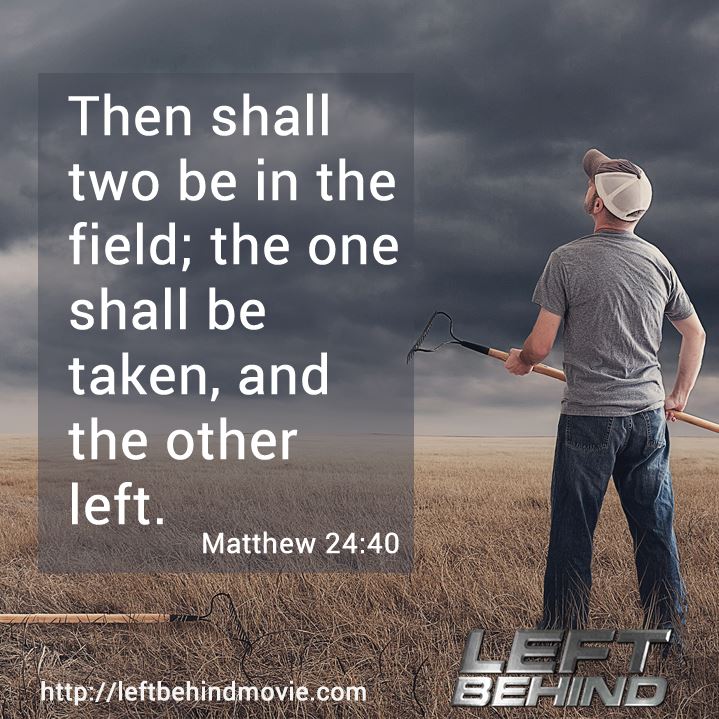
Matthew that you’ll see in the official Left Behind image included to
your left. The passage states:
“Then shall two be in the field; the one shall be taken and the other left”.
And this is where we get the term “left behind”… Jesus said “one shall be taken and the other left.”
Pretty
simple, no? It appears from this passage that Jesus is describing an
event where some people actually do “get taken” and the others are “left
behind.” It must be a rapture then.
Or maybe not.
As
I have explained before, the chapter of Matthew 24 is a chapter where
Jesus describes the events that will lead up to the destruction of the
temple which occurred in AD 70. That’s not so much my scholarly opinion
as it is what Jesus plainly states in the first few verses of Matthew
24; it is a context pretty difficult to explain away since Jesus says
“this temple will be destroyed” and his disciples ask, “please, tell us
when this will happen.” The rest of the discourse is Jesus prophesying
the events that will lead up to the temple’s destruction, which we know
historically unfolded as Jesus had predicted. (As I have alluded to in What Jesus Talked About When He Talked About Helland Don’t Worry The Tribulation Is In The Past,
if one does not understand the significance of the destruction of the
temple to ancient Judaism, one will have a very hard time understanding
what Jesus talks about when he talks about “the end.”)
Anyhow,
during the end of this discourse in Matthew we hit the “rapture” verse:
“one will be taken and one will be left.” Surely, this part must be
about the future, and Jesus MUST be describing a rapture. Since that’s what my childhood pastor taught me, it’s probably a good idea to stick with that.
Just
one problem: Matthew 24 isn’t the only place where Jesus talks about
“some being taken and some being left behind.” Jesus also discusses this
in Luke 17 when he says:
“I tell you, on that night two people will be in one bed; one will be taken and the other left.35 Two women will be grinding grain together; one will be taken and the other left.”
Building
a compelling case for the rapture yet? Not quite. Check this out:
Jesus’ disciples in the Luke version of the discourse must have been
interested in this left behind stuff, because they ask a critical
followup question. However, they actually seem more concerned with those
who were “taken” than those who were “left behind” and ask Jesus for a
little more information on this whole getting taken away stuff.
“Where, Lord?” is the question of the disciples. Where did all of these people go??
If
this were a passage about the “rapture” as depicted in the Left Behind
movie, one would expect Jesus to answer something to the point of “they
were taken to be with me to wait out the tribulation.” But, that’s not
what Jesus says. Instead, Jesus gives them a blunt answer about those
who were “taken”: “just look for the vultures, and you’ll find their bodies.” (v37)
That’s right. The ones who were “taken” were killed. Not exactly the blessed rapture.
The
Roman occupation was brutal, and when they finally sacked the city and
destroyed the temple in AD70, things got impressively bloody. To be
“taken” as Jesus prophesied, was to be killed by the invading army. This
is precisely why, in this passage and the Matthew version, Jesus gives
all sorts of other advice that makes no sense if this is a verse about
the rapture. Jesus warns that when this moment comes one should flee
quickly– to not even go back into their house to gather their
belongings– and laments that it will be an especially difficult event
for pregnant and nursing mothers. He even goes on to warn them that if
they respond to the army with resistance (the very thing that causes the mess in the lead-up to AD70),
they’ll just get killed (“whoever seeks to save his life will lose
it”). Jesus, it seems, wants his disciples to get it: when the Roman
army comes, flee quickly or else you might not be left behind!
Surely,
Jesus is not talking about a rapture. He’s not warning people to avoid
missing the rapture because they went home to get their possessions…
he’s talking about fleeing an advancing army and not doing anything stupid that will get them killed (v 30-34).
Very
practical advice for his original audience and would have come in handy
for those who wanted to avoid being “raptured” (slaughtered) by the
Roman army.
And so my friends, this is the most ironic thing the Left Behind movie won’t tell you: in the original “left behind” story Jesus tells in the Gospels, the ones who are “left behind” are actually the lucky ones.
So
the next time folks tell you that they don’t want to be “left behind,”
you might want to tell them to be careful what they wish for. -Benjamin Corey, link
of course Christians will be left behind
Preface (sigh); Don't hear what I'm not saying. I am not
- See more at: http://davewainscott.blogspot.com/2009/05/of-course-christians-will-be-left.html#sthash.5DxrH5Co.dpuf
-- Adam Maarschalk adds some evidence from sources in 1700s and 1800s:
In our study of Matthew 24:36-51,
I also proposed that Jesus said it would be better to be “left behind”
than to be “taken,” and noted that 2-3 centuries ago this was taught by
John Gill (1746-1763) and Albert Barnes (1834). Benjamin Corey does an
excellent job showing the revealing connection between what Jesus says
in Luke 17 and what He says in the more frequently quoted Matthew 24:40.
His article also comes at a good time, less than two weeks before the remake of the Left Behind movie hits the theaters on October 3rd. Hopefully the theology in this film will soon be left behind by many followers of Christ. link
Morpheus:
All of our lives we have fought this war. Tonight I believe we can end
it. Tonight is not an accident. There are no accidents. We have not come
here by chance. I do not believe in chance... I do not see coincidence, I see providence, I see
purpose. I believe it is our fate to be here. It is our destiny. I
believe this night holds for each and every one of us the very meaning
of our lives...
Niobe: What if you..and the prophecy.. are wrong?
Morpheus:Then tomorrow we may all be dead, but how would that be different from
any other day? This is a war, and we are soldiers. Death can come for us
at any time, in any place... Now consider the alternative. What if I am right? What if the prophecy
is true? What if tomorrow the war could be over. Isn't that worth
fighting for? Isn't that worth dying for?link
--
the best-known quote from the PesachHaggadah is, "why is this night different from
all other nights?" This line is usually recited by the youngest person at the
table (or at least, the youngest person capable of reciting it). It is meant to
express the child's confusion at the difference between a typical every-day or
holiday meal and the unusual features of the seder.
link
Many who have heard of Martin Buber's seminal "I and Thou" assume it is about a "me and God" relationship.
That is not ultimately wrong;
but not completely right, either.
Some have suggested the title should be translated "I and You," or in Spanish, "Yo y Tu" (informal "you").
Not quite wrong;
not perfectly right.
As Nicholas Lash notes (citing Walter Kaufman)"
The first problem for the English-speaking reader of the book is to know how to take the title. Buber is writing about personal relationships between human beings, and between human beings and their world--about (we might say) friendship and friendliness. What pronoun shall we use for friendship's address? In many languages, the choice would be straightforward. Thus, in Buber's German, 'Du is spontaneous and unpretentious, remote from formality, pomp and dignity.' It is no longer so with Thou. "Thou can mean many things, but it has no place whatsoever in the language of direct, nonliterary, spontaneous human relationships'
Moreover, in modern English, Thou brings God to mind and yet, until the third and final part of the book, Buber speaks hardly at all of address to God.. {though} privately Buber referred to the works as "Prolegomena to a Philosophy of Religion." -Lash, pp 184-185 of Easter in Ordinary
Uh, good thing the publisher DID convince Buber to change the title...otherwise we may have never heard of this classic(:\
From prologue of I and Thou, pg. 14-15:
“I-You sounds unfamiliar. What we are accustomed to is I-Thou. But man’s attitudes are manifold, and Thou and You are not the same. Nor is Thou very similar to the German Du.
German lovers say Du to one another, and so do friends. Du is spontaneous and unpretentious, remote from formality, pomp, and dignity.
What lovers or friends say Thou to one another? Thou is scarcely ever said spontaneously.
Thou immediately brings to mind God; Du does not. And the God of whom it makes us think is not the God to whom one might cry out in gratitude, despair, or agony, not the God of whom one complains or prays spontaneously; it is the God of the pulpits, The God of the holy tone.
When men pray spontaneously or speak directly to God, without any mediator, without any intervention of formulas, when they speak as their heart tells them to speak instead of repeating what is printed, do they say Thou? How many know the verb forms Thou commands?
The world of Thou has many mansions. Thou is a preacher’s word but also dear to anticlerical romantic poets. Thou is found in Shakespeare and at home in the English Bible, although recent versions of the Scriptures have tended to dispense with it. Thou can mean many things, but it has no place whatever in the language of direct, nonliterary, spontaneous human relationships.
If one could liberate I-Thou from affectation, the price for that would still involve reducing it to a mere formula, to jargon. But suppose a man wrote a book about direct relationships and tried to get away from the formulas of theologians and philosophers: a theologian would translate it and turnIch und Du into I and Thou.” link
Great piece by Morgan Meis excerpted and linked below.
His opening story reminded me of the abandoned military equipment my son and I played on/posed on in the Golan Heights; see video below 5:45ff
--
THE ROAD TO JERUSALEM
Highway 1 is a normal highway, winding up the hills from Tel Aviv to Jerusalem. And it is anything but a normal highway. BY MORGAN MEIS
The highway from Tel Aviv to Jerusalem, Highway 1, looks like any other highway in the world. This fact alone is disconcerting. The road to Jerusalem should be special. Somewhere deep down I suppose I wanted it to be a dirt road, a cobblestone road, anything but a normal highway. I even fantasized that the ascent from Tel Aviv to Jerusalem would not happen by means of a road at all. It would just happen. In reality, it is a highway. A highway filled with too many cars and bastard truck drivers probing the limits of vehicular stability and good sense.
About two thirds of the way up to Jerusalem, however, an interesting and unusual sight does present itself. It is the sight of abandoned vehicles along the side of the road. They aren’t normal vehicles, passenger cars or trucks. The vehicles are painted in the telltale green that only gets slapped on things owned by the military. You don’t get much time to inspect these military vehicles as you drive by on the highway. It is hard to guess their purpose, though it looks like they’ve been there for a while, remnants from something that happened in the first
half of the 20th century.
My friend Ori, who was driving me from Ben-Gurion airport outside of Tel Aviv, explained that the vehicles were remnants of the military convoy that broke the Arab siege of Jerusalem during the War of Independence in 1948. The convoy was led by an American general, Mickey Marcus, Ori told me. “We call him the first Israeli general—aluf in Hebrew—since biblical days, since Joshua blowing his trumpet at the walls of Jericho.” The aluf, Ori said, was shot dead in the final days of the campaign. But the convoy made it through to Jerusalem.
For a week or so, while exploring Jerusalem old and new, the sight of those abandoned military vehicles along the road sat unbothered in the back of my brain. Then, I saw them again on a trip back down to Tel Aviv to visit friends. I began to understand what had nagged at me when I saw the vehicles the first time.
Half-destroyed military vehicles do not normally sit alongside a modern highway. These vehicles are monuments to the military struggles that attend the founding of the modern state of Israel. Such monuments might, in another country, come with an acknowledgment. No such luck in Israel. The armored troop carriers are presented without comment, without informational signs or explanation. The monuments are completely visible for everyone to see at the side of the road, and, at the same time, completely invisible, completely hidden in terms of symbolic value.
There is, I thought to myself, an unusual historical consciousness at work here. But I found myself lacking the proper set of keys, the proper codes to unlock the symbols, to understand how to read this ambivalent historical marker.
In Tel Aviv, I happened to be visiting my friend Roy Brand who, along with Ori Scialom and Keren Yeala-Golan, curated a project called The Urburb: Patterns of Contemporary Living. The Urburb was exhibited at the Israeli Pavilion of the 14th International Architecture Exhibition at the Venice Biennial. When I saw The Urburb, it had been recreated at Artport, a gallery on Ben Tsvi Road in Tel Aviv.
In his essay “Machine Event” for the publication that accompanies The Urburbexhibit, Roy describes the project like this:
Our installation is simple and direct. Four printers, customized for the pavilion’s space, draw images on desert sand, and then erase them. Every few minutes a new image replaces the previous one. Together they tell the stories of one hundred years of modernist construction in Israel. From the Ottoman period through the British Mandate for Palestine, visitors enter the construction site that became modern Israel.
Watching the customized printers drawing their images in the sand has a mesmerizing effect. I felt like I could stand there for hours, just bearing witness as the machines scratched their images and then erased them, over and over again. As I watched this process, the seeds of understanding began slowly to germinate. I started to realize, I’m not in an ancient land at all. I’m in a place that is engaged in a vast experiment with the radically new.
Or, as Roy puts it, Israel is the place of the “old-new.”
Israel is an old-new invention, a modernist project grafted onto a historical landscape. The age-old myth of a biblical legacy joins the modern myth of New Towns magically sprouting from the sand. This combination suggests a divine, ex-nihilo rebirth. Modernist construction, evident everywhere around the globe, is wholly dominant in a country whose majority was built from 1914 to the present.
So, it is not crazy at all to think of Israel as a land of brand new highways and modernist construction project...continued